
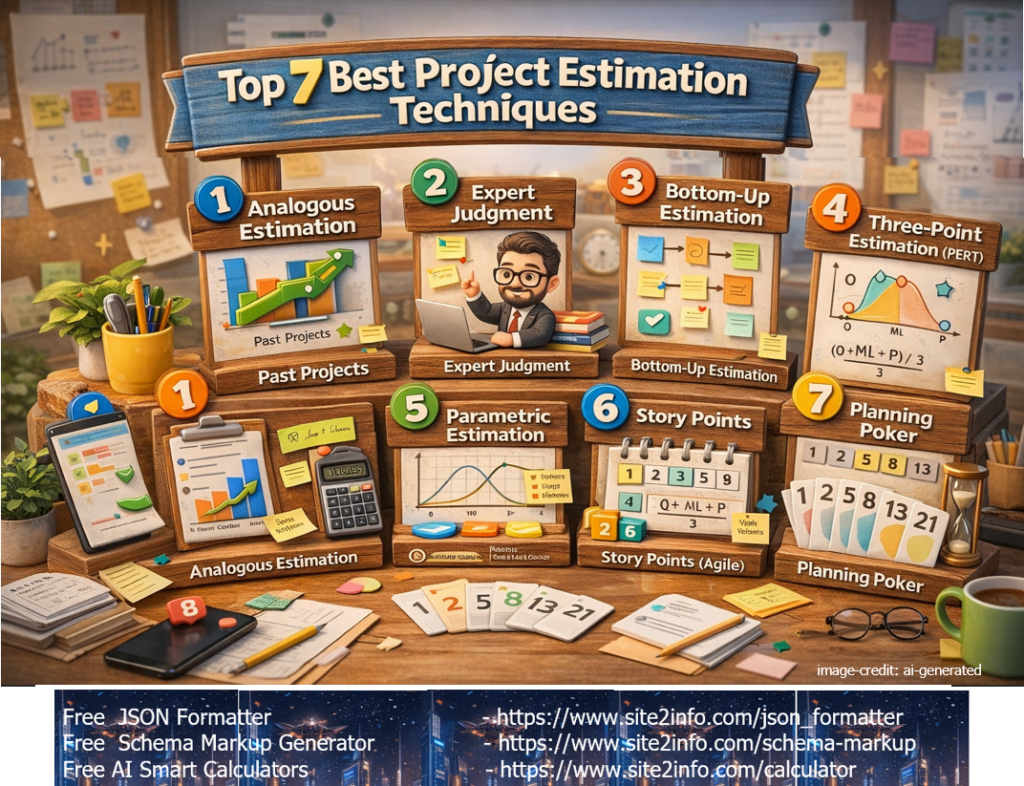
Detailed list of 7 Best Project Estimation Techniques
1️⃣ Expert Judgment
What it is:
Estimation based on the experience of senior team members or subject-matter experts.
Best for:
- New or complex projects
- Early-stage estimation
Pros: Fast, experience-driven
Cons: Can be biased
2️⃣ Analogous Estimation
What it is:
Estimating based on similar past projects.
Best for:
- Early planning
- High-level budgeting
Pros: Quick and simple
Cons: Less accurate if projects differ
3️⃣ Parametric Estimation
What it is:
Uses statistical formulas (e.g., cost per feature, hours per module).
Example:
10 pages × 8 hours/page = 80 hours
Best for:
- Repetitive or standardized work
Pros: Data-driven
Cons: Needs reliable historical data
4️⃣ Bottom-Up Estimation (Most Accurate)
What it is:
Estimate each task individually and sum them.
Best for:
- Detailed project plans
- Execution phase
Pros: Highly accurate
Cons: Time-consuming
5️⃣ Three-Point Estimation (PERT)
What it is:
Uses 3 values:
- Optimistic (O)
- Most Likely (M)
- Pessimistic (P)
Formula:(O + 4M + P) / 6
Best for:
- Risk-heavy projects
Pros: Accounts for uncertainty
Cons: Slightly complex
6️⃣ Agile Estimation (Story Points / Planning Poker)
What it is:
Estimation using relative sizing instead of hours.
Best for:
- Agile / Scrum teams
Pros: Team-based, flexible
Cons: Not ideal for fixed-scope contracts
7️⃣ Function Point / Use Case Estimation
What it is:
Estimation based on functional complexity rather than time.
Best for:
- Large enterprise software
- Regulated industries
Pros: Technology-independent
Cons: Requires expertise
🏆 Which Estimation Technique Is Best?
There is no single best technique.
Best practice: combine multiple methods.
⭐ Most commonly used combo:
- Early stage: Analogous + Expert Judgment
- Planning stage: Bottom-Up + Three-Point
- Agile projects: Story Points + Velocity
✅ Real-World IT Examples
🔹 1️⃣ Analogous Estimation – Website Development
Scenario:
Client asks: “How long will a 20-page corporate website take?”
Approach:
Last similar website took 6 weeks → estimate 5–7 weeks.
Why it works:
- Early proposal stage
- No detailed requirements yet
✅ Used for: Pre-sales, ballpark budgeting
❌ Not used for: Final contracts
🔹 2️⃣ Bottom-Up Estimation – E-Commerce Platform
Scenario:
Building an eCommerce site (Adobe Commerce / Shopify Plus)
Approach:
Break into tasks:
- UI Design → 40 hrs
- Backend APIs → 120 hrs
- Checkout → 60 hrs
- Payment Gateway → 30 hrs
- QA → 50 hrs
Total = 300 hrs
Why it works:
- Highly accurate
- Clear task ownership
✅ Best for: Fixed-scope projects, delivery planning
❌ Risk: Time-consuming to prepare
🔹 3️⃣ Three-Point Estimation – Payment Gateway Integration
Scenario:
Integration with external payment provider (high uncertainty)
| Estimate Type | Time |
|---|---|
| Optimistic (O) | 5 days |
| Most Likely (M) | 8 days |
| Pessimistic (P) | 14 days |
PERT Formula:
(5 + 4×8 + 14) ÷ 6 = 8.5 days
Why it works:
- Accounts for risk & unknowns
- Better stakeholder confidence
✅ Best for: Integration, migration, legacy systems
🔹 4️⃣ Agile Delivery Estimation – Mobile App Development
Scenario:
Scrum team delivering features in sprints
Approach:
- User Story A → 5 points
- User Story B → 8 points
- User Story C → 3 points
Team Velocity: 20 points / sprint
→ Delivery in 1 sprint
Why it works:
- Flexible
- Team-driven
- Continuous improvement
✅ Best for: Evolving requirements, product development
❌ Not ideal: Fixed-price contracts