AI Tools To Find & Compare Best AI Tools & Analytics on AI Usage

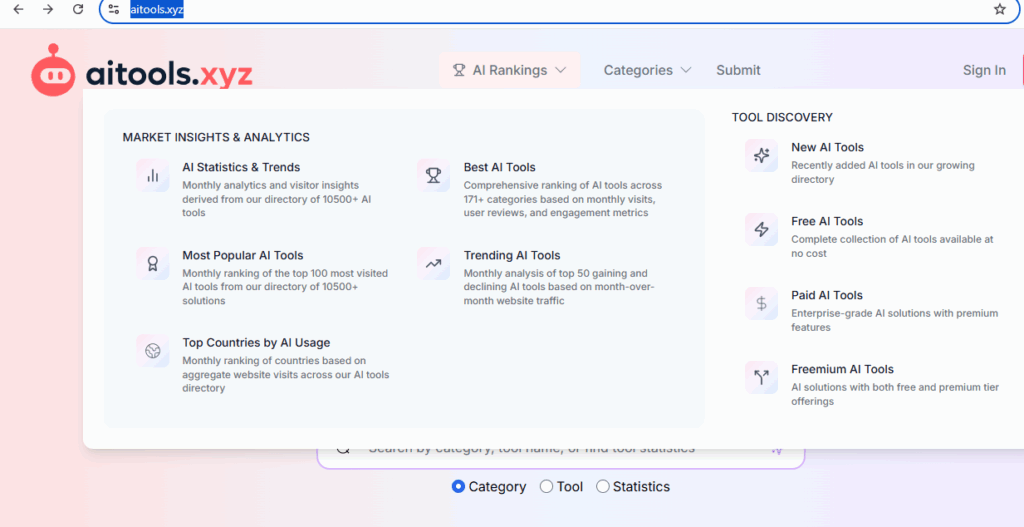
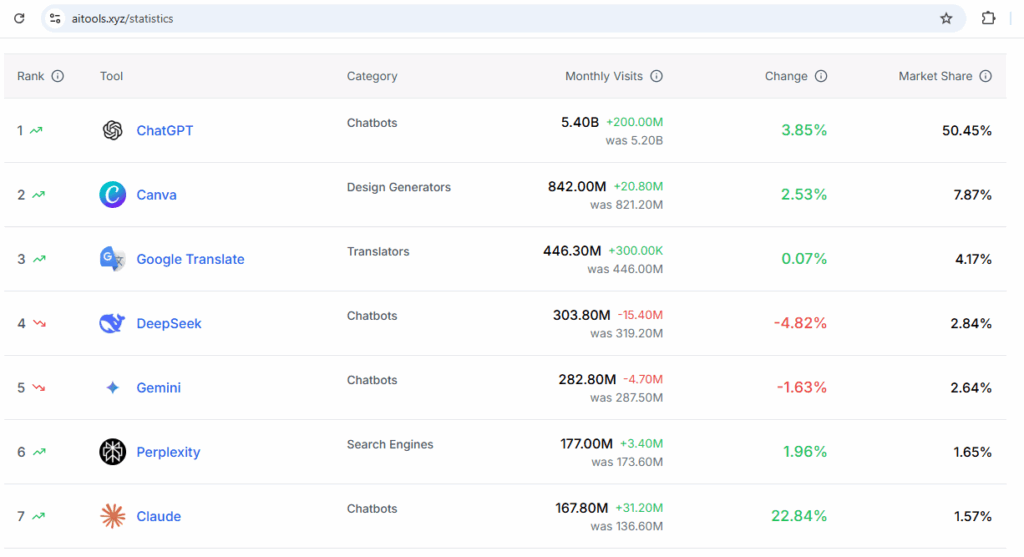
AItools.xyz :: The AI Tools Directory — Discover, Compare, and Choose the Best AI for Your Needs

AItools.xyz exists to help users discover, evaluate, and compare AI tools across categories like productivity, development, content creation, automation, and research. The platform serves as a centralized directory where individuals and businesses can explore emerging AI solutions, stay updated with new launches, and find the right tools based on features, pricing, and use cases.

Define Project Management Life Cycle

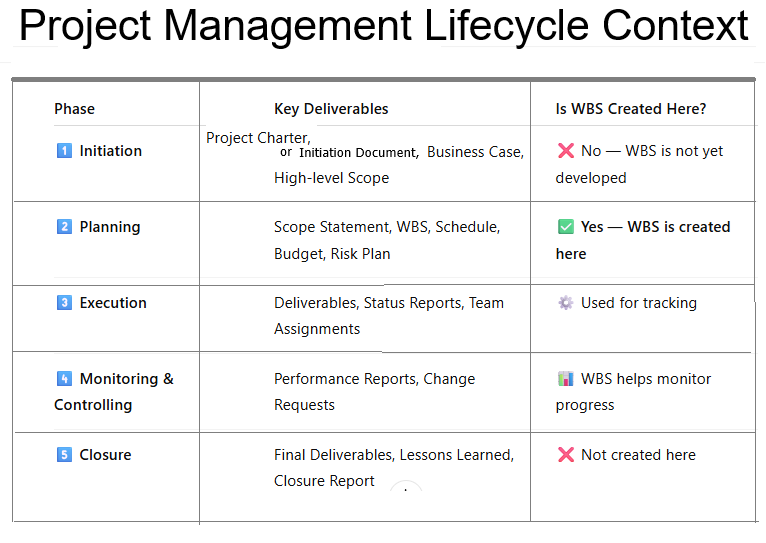
These are the 5 Project Management Process Groups defined by PMI (Project Management Institute) in the PMBOK (Project Management Body of Knowledge).

These are NOT SDLC phases — they are Project Management Phases used in any type of project, including IT, software, construction, and business operations.


1️⃣ Initiation Phase

Purpose: Start the project formally
Activities include:

  • Define project goals
  • Create Project Charter
  • Identify stakeholders
  • High-level scope & feasibility

2️⃣ Planning Phase

Purpose: Plan how the project will be executed
Activities include:

  • Detailed project plan
  • Scope planning
  • Schedule & timeline
  • Budget planning
  • Risk management plan
  • Resource planning
  • Communication plan

3️⃣ Execution Phase

Purpose: Do the actual work
Activities include:

  • Team execution
  • Development, design, testing
  • Managing stakeholders
  • Quality management
  • Task assignments
  • Delivering project outputs

4️⃣ Monitoring & Controlling Phase

Purpose: Track progress and control deviations
Activities include:

  • Monitor KPIs
  • Control scope changes
  • Track timeline and budget
  • Ensure quality standards
  • Issue/risk management
  • Status reporting

5️⃣ Closure Phase

Purpose: Formally end the project
Activities include:

  • Final deliverables
  • Approvals and sign-off
  • Documentation
  • Lessons learned
  • Release resources
  • Project completion report

Explain all SDLC Methodologies or SDLC Models

SDLC (Software Development Life Cycle) methodologies are structured frameworks used to plan, design, build, test, and maintain software

 It breaks down the complex process into distinct phases, providing a framework that helps manage time, resources, and risks throughout the development of a software product.

Types of SDLC Methodologies or SDLC Models

1️⃣ Waterfall Model

A linear and sequential development model where each phase must be completed before moving to the next.

Key Features:

  • Requirements → Design → Development → Testing → Deployment → Maintenance
  • No going back to previous phases
  • Best for projects with clear, fixed requirements

Used In:

Government, manufacturing, construction, highly controlled environments.


2️⃣ Iterative Model

The product is built step-by-step in small cycles, with feedback after each iteration.

Key Features:

  • Build → Test → Improve → Repeat
  • Each version is better than the previous
  • Reduces risk early
  • Good when complete requirements are not known initially

Used In:

Prototyping, early-stage product development, systems requiring gradual evolution.


3️⃣ Spiral Model

A risk-driven software development model combining Waterfall + Iterative + Risk Management.

Key Features:

  • Each spiral = Planning → Risk Analysis → Engineering → Evaluation
  • Focuses on risk reduction
  • Excellent for large, complex, high-risk projects

Used In:

Defense, aerospace, expensive systems where failure is costly.


4️⃣ V-Model (Verification & Validation Model)

A “V-shaped” model where testing activities happen in parallel with development phases.

Key Features:

  • Each development phase has a corresponding testing phase
  • Very structured and strict
  • Great for systems requiring validation & compliance

Used In:

Healthcare, automotive, safety-critical software, regulated industries.


5️⃣ Big Bang Model

Little to no planning — development starts immediately and evolves as needed.

Key Features:

  • No formal process
  • Suitable only for small, experimental, or short projects
  • Very high risk and unpredictable

Used In:

POCs, experiments, small teams building quick concepts.


6️⃣ Agile Model

An adaptive, flexible, iterative model where development happens in small increments (Sprints).

Key Features:

  • Continuous improvement
  • Responding to change over following a strict plan
  • Customer involvement at every step
  • Works in Sprints (Scrum) or flows (Kanban)

Used In:

Modern software development, ecommerce, SaaS, mobile apps, startups.

📌 Are these the only SDLC models?

No — but they are the most standard and widely used models.

Other recognized SDLC approaches include:

  • Incremental Model
  • Prototype Model
  • RAD (Rapid Application Development) Model
  • DevOps Model
  • Hybrid Model (Agile + Waterfall)
  • Scrum Framework (under Agile)
  • Kanban (under Agile)

But the core SDLC models (commonly taught and used) are exactly the ones you included.

HIPAA, FHIR & Their Healthcare Data Security Concern

HIPAA (Health Insurance Portability and Accountability Act) and FHIR (Fast Healthcare Interoperability Resources) are interconnected in the healthcare sector.

HIPAA sets the standards for protecting sensitive patient information, while FHIR facilitates the secure exchange of healthcare data through APIs. Together, they ensure that healthcare institutions can create and manage compliant systems that protect patient data while enabling interoperability. FHIR also includes security standards that help maintain HIPAA compliance during data sharing and integration

🛡️ What is HIPAA?

HIPAA (Health Insurance Portability and Accountability Act) is a U.S. federal law enacted in 1996 to protect sensitive patient health information.

  • Key Goals:
    • Ensure confidentiality, integrity, and availability of Protected Health Information (PHI)
    • Set standards for electronic health transactions
    • Mandate safeguards for data privacy and security
  • Covered Entities:
    • Healthcare providers
    • Health plans
    • Healthcare clearinghouses
    • Business associates handling PHI
  • Security Rules:
  • Administrative safeguards (e.g., training, policies)
  • Physical safeguards (e.g., facility access controls)
  • Technical safeguards (e.g., encryption, access control)

🔗 What is FHIR?

FHIR (Fast Healthcare Interoperability Resources) is a data standard developed by HL7 for exchanging healthcare information electronically.

  • Purpose: Facilitate seamless, secure data sharing across systems like EHRs, mobile apps, and cloud platforms
  • Structure: Uses RESTful APIs and standardized data formats (JSON, XML)
  • Resources: Includes patient, observation, medication, appointment, etc.

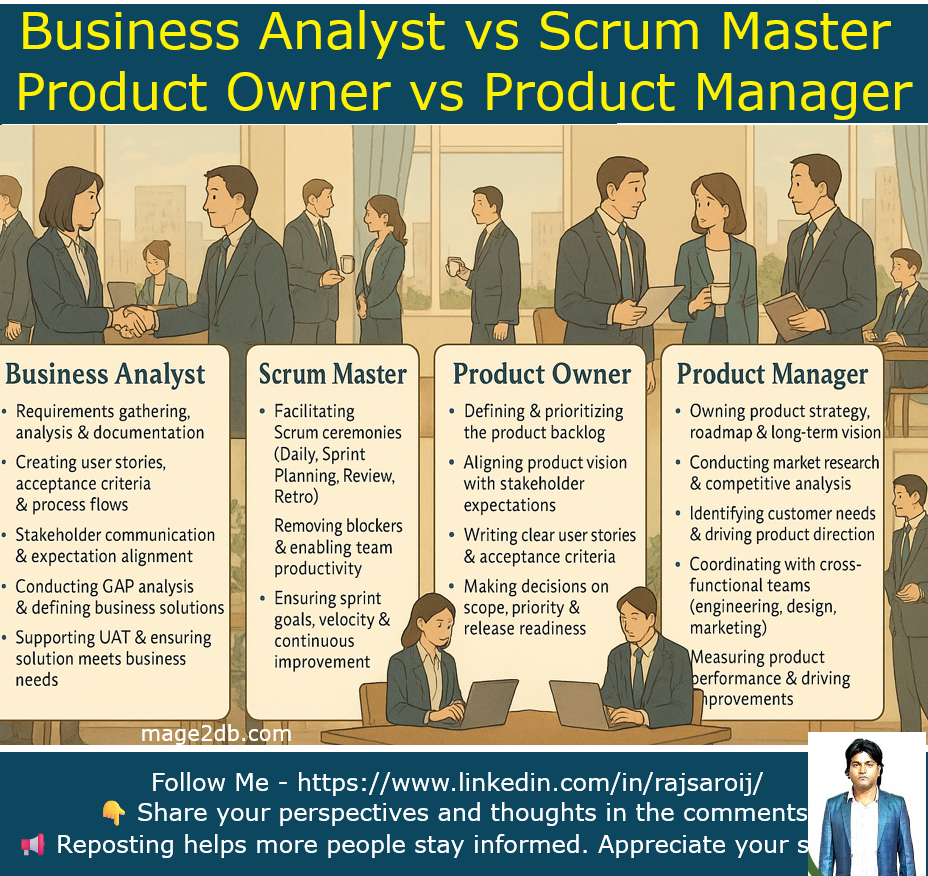
Business Analyst vs Scrum Master vs Product Owner vs Product Manager 

In today’s Agile-driven organizations, clarity of roles is not just important — it’s essential for delivery, collaboration, and stakeholder alignment.
To make things simpler, I created a Ghibli-style professional banner highlighting the key roles & responsibilities of:
👤 Business Analyst: (Roles & Responsibilities )

  • Requirements gathering, analysis & documentation
  • Creating user stories, acceptance criteria & process flows
  • Stakeholder communication & expectation alignment
  • Conducting GAP analysis & defining business solutions
  • Supporting UAT & ensuring solution meets business needs


👤 Scrum Master: (Roles & Responsibilities )

  • Facilitating Scrum ceremonies (Daily, Sprint Planning, Review, Retro)
  • Removing blockers & enabling team productivity
  • Coaching the team on Agile/Scrum practices
  • Ensuring sprint goals, velocity & continuous improvement
  • Protecting the team from scope creep & distractions


👤 Product Owner: (Roles & Responsibilities )

  • Defining & prioritizing the product backlog
  • Aligning product vision with stakeholder expectations
  • Writing clear user stories & acceptance criteria
  • Making decisions on scope, priority & release readiness
  • Ensuring maximum value delivery each sprint


👤 Product Manager: (Roles & Responsibilities )

  • Owning product strategy, roadmap & long-term vision
  • Conducting market research & competitive analysis
  • Identifying customer needs & driving product direction
  • Coordinating with cross-functional teams (engineering, design, marketing)
  • Measuring product performance & driving improvements


Each role plays a unique part in ensuring successful product delivery:
🔹 BA → Translates business needs into clear requirements
🔹 SM → Empowers the Agile team and removes blockers
🔹 PO → Owns the product backlog + sprint value
🔹 PM → Defines long-term product vision & strategy
When these roles work together smoothly, teams deliver faster, better, and with more value.

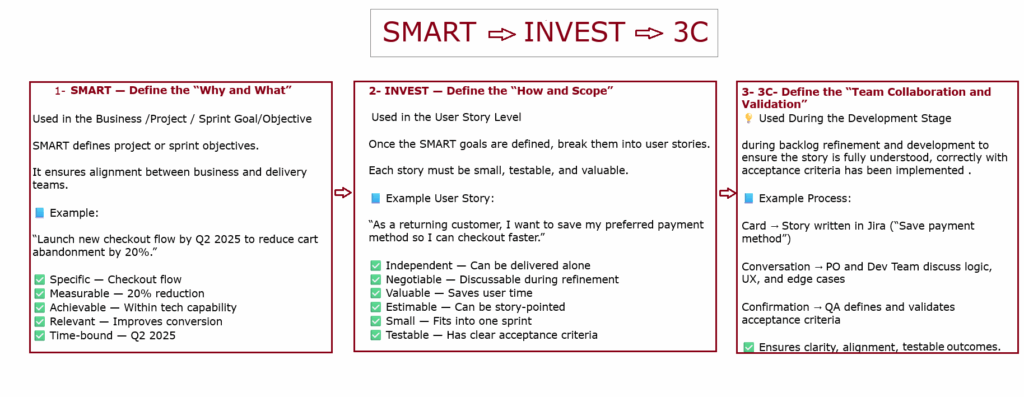
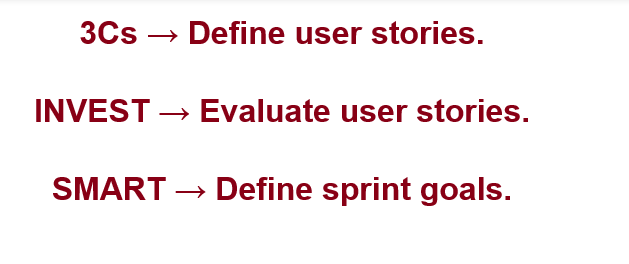
Explain 3Cs Model, Invest Model, Smart Model in Scrum / Agile

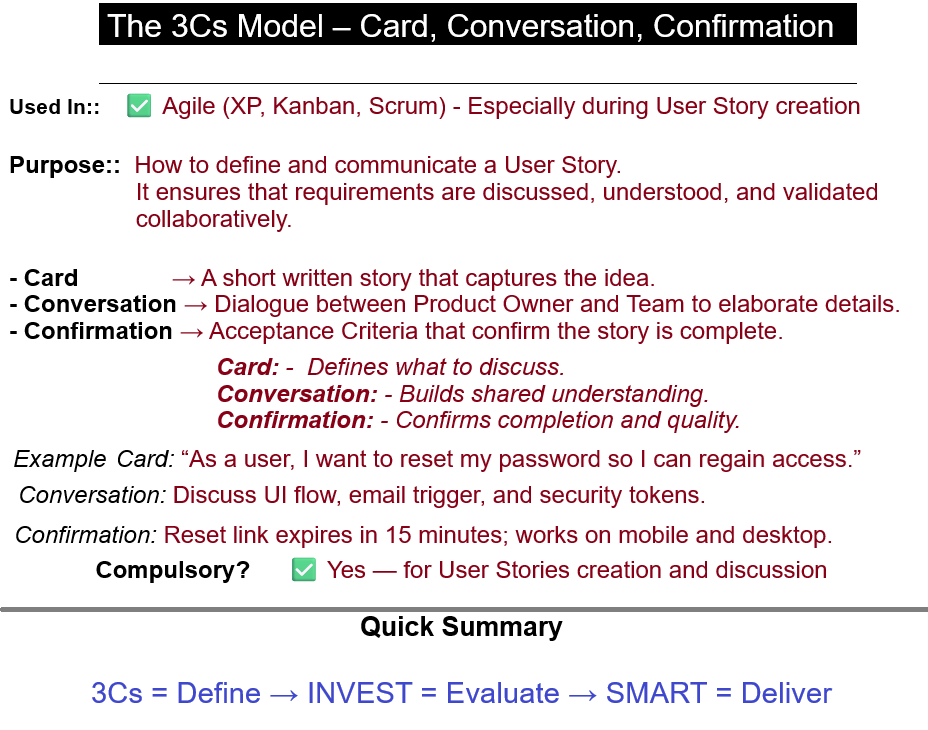
The 3Cs Model in Agile (Card, Conversation, Confirmation)

The 3Cs Model, introduced by Ron Jeffries (one of the Agile pioneers), defines how User Stories should be created and understood in Agile frameworks like Scrum. It ensures clarity, collaboration, and validation in requirement gathering.

Card → A short written story that captures the idea → By Product Owner
Conversation → Dialogue between Product Owner and Team to elaborate details → By Product Owner & Development Team & (facilitated by Scrum Master)
Confirmation → Acceptance Criteria that confirm the story is complete → By Product Owner & QA Team

The Scrum Master facilitates the Conversation, usually during Backlog Refinement or Sprint Planning, ensuring effective communication, mutual understanding, and that the timebox is respected.

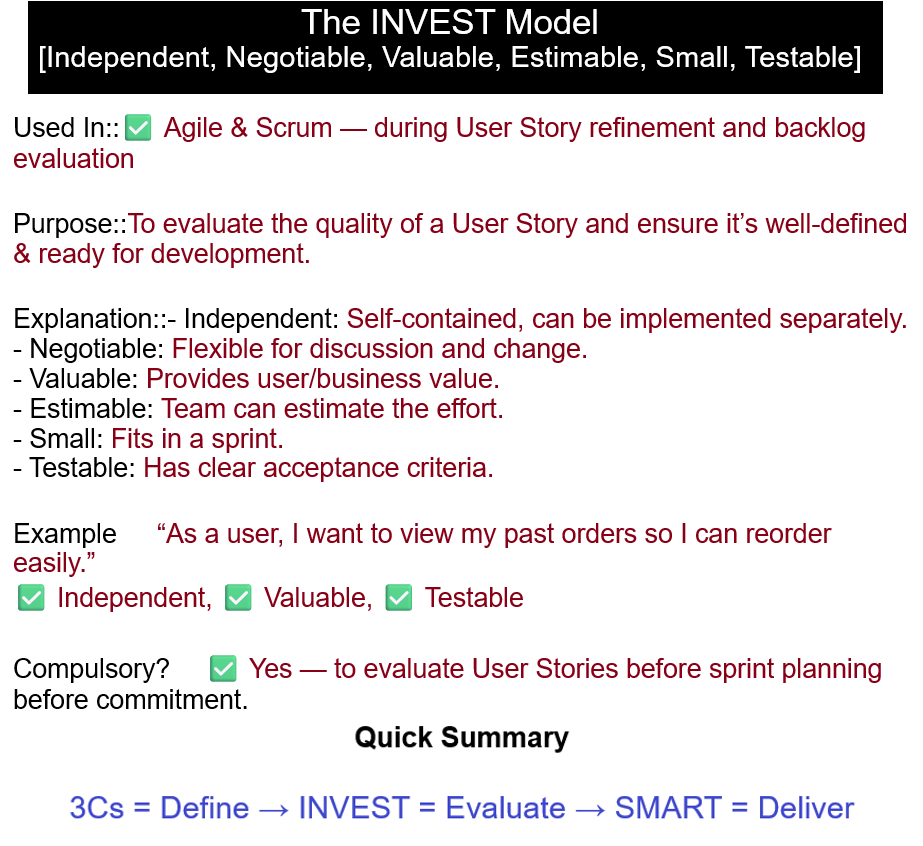
INVEST Model: ( (Define the “How and What”))

To evaluate the quality of a User Story and ensure it’s well-defined and ready for development.

Independent: Self-contained, can be implemented separately.
Negotiable: Flexible for discussion and change.
Valuable: Provides user/business value.
Estimable: Team can estimate the effort.
Small: Fits in a sprint.
Testable: Has clear acceptance criteria.

The SMART Model: (Define the “Why and What”)

To make sure goals and deliverables are clear, measurable, and realistic within the sprint timeline.

Specific: Clear and focused.
Measurable: Quantifiable results.
Achievable: Possible within sprint capacity.
Relevant: Aligns with business or product goals.
Time-bound: Achievable within the sprint.

https://www.linkedin.com/pulse/using-smart-goals-project-planning-projectmanagementinformation-wtdkf