PCI (cards), HIPAA (health), GDPR (EU data), SOC 2 (service Org controls)

1. PCI-DSS (Payment Card Industry Data Security Standard)

What it is:
PCI-DSS is a global security standard for any business that stores, processes, or transmits credit or debit card data.

“Protecting credit/debit card data during storage, processing, and transmission.”

Who must comply:

  • Online stores
  • Banks
  • Payment gateways
  • SaaS platforms that handle payments
  • Any company accepting Visa, Mastercard, Amex, etc.

What it protects:
Card numbers, CVV, expiration dates, and transaction data.

Key requirements include:

  • Encrypting card data
  • Restricting access to payment systems
  • Regular security scans and penetration testing
  • Secure network and firewall configurations
  • Logging and monitoring access

Why it matters:
Without PCI-DSS, customer card data can be stolen, leading to fraud, chargebacks, fines, and brand damage.


2. SOC 2 (Service Organization Control 2)

What it is:
SOC 2 is a compliance framework that proves a company protects customer data in cloud and SaaS environments.

Controls for service organizations (especially cloud/SaaS) on Security, Availability, Processing Integrity, Confidentiality, and Privacy (Trust Services Criteria)

Who needs it:

  • SaaS companies
  • Cloud platforms
  • Fintech apps
  • Data platforms
  • B2B software providers

SOC 2 evaluates five trust principles:

  1. Security
  2. Availability
  3. Processing integrity
  4. Confidentiality
  5. Privacy

What it checks:

  • How you secure customer data
  • How you manage system uptime
  • How access is controlled
  • How incidents are handled
  • How data is stored and deleted

Why it matters:
SOC 2 is often required before enterprise clients will sign a contract. It proves your company is enterprise-grade and trustworthy.


3. GDPR (General Data Protection Regulation)

What it is:
GDPR is a European data privacy law that protects the personal data of people in the EU.

Protecting personal data and privacy rights of EU residents.

Who must follow it:
Any company worldwide that collects or processes data from EU residents.

What counts as personal data:

  • Name
  • Email
  • IP address
  • Location
  • Browsing behavior
  • Any data that can identify a person

Key GDPR rights:

  • Right to access
  • Right to delete
  • Right to correct
  • Right to know how data is used
  • Right to withdraw consent

What companies must do:

  • Collect only necessary data
  • Get clear user consent
  • Secure stored data
  • Report breaches
  • Allow users to delete their data

Why it matters:
GDPR violations can lead to fines of up to 4 percent of global revenue and massive loss of customer trust.


4. HIPAA (Health Insurance Portability and Accountability Act)

What it is:
HIPAA is a US law that protects medical and health information.

Safeguarding sensitive Protected Health Information (PHI).

Who must comply:

  • Hospitals
  • Clinics
  • Insurance companies
  • Health apps
  • Healthcare SaaS platforms

What it protects:
Patient data such as

  • Medical records
  • Diagnoses
  • Prescriptions
  • Test results
  • Billing information

This data is called PHI (Protected Health Information).

Key requirements:

  • Secure storage of patient data
  • Access controls
  • Audit trails
  • Data encryption
  • Breach reporting

Why it matters:
Healthcare data is extremely sensitive. HIPAA ensures privacy, safety, and patient trust.


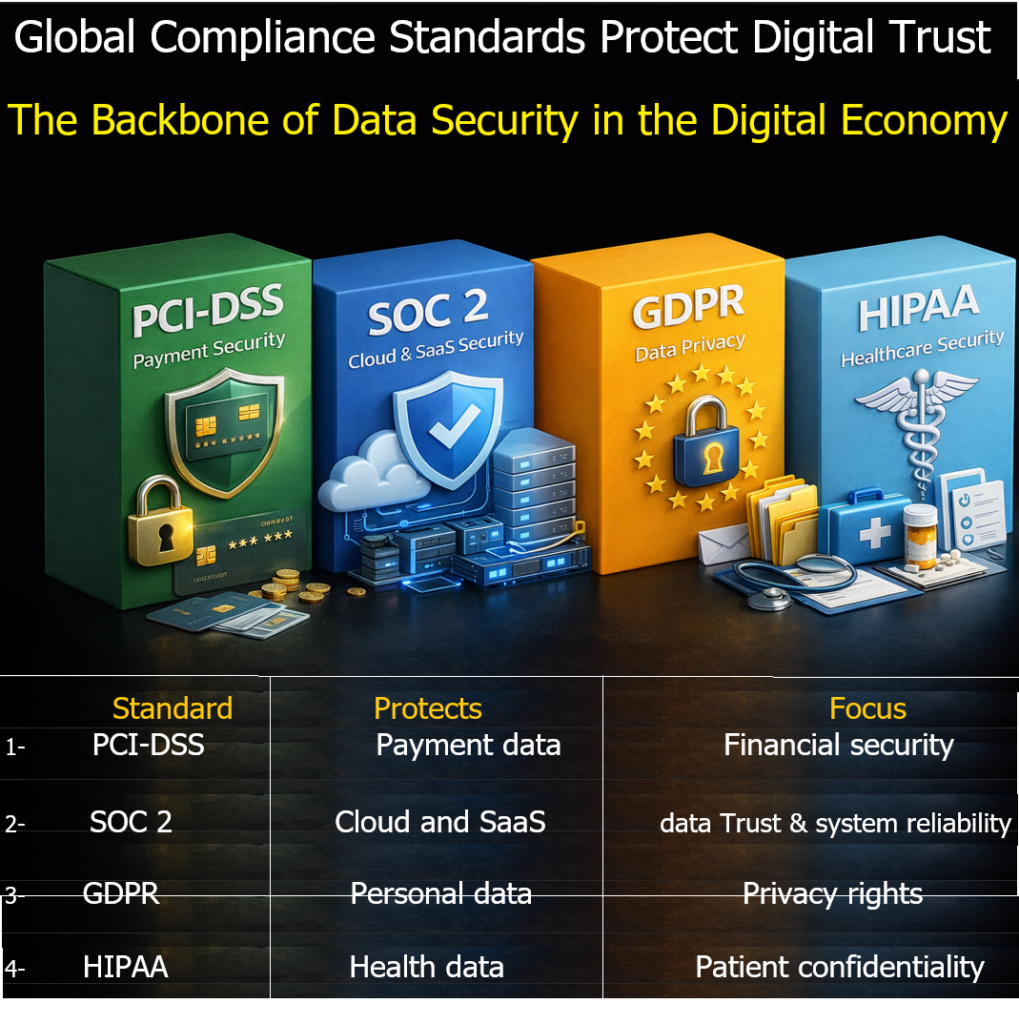
How These Four Work Together

StandardProtectsFocus
PCI-DSSPayment dataFinancial security
SOC 2Cloud and SaaS dataTrust and system reliability
GDPRPersonal dataPrivacy rights
HIPAAHealth dataPatient confidentiality

A modern digital company may need all four depending on its industry.
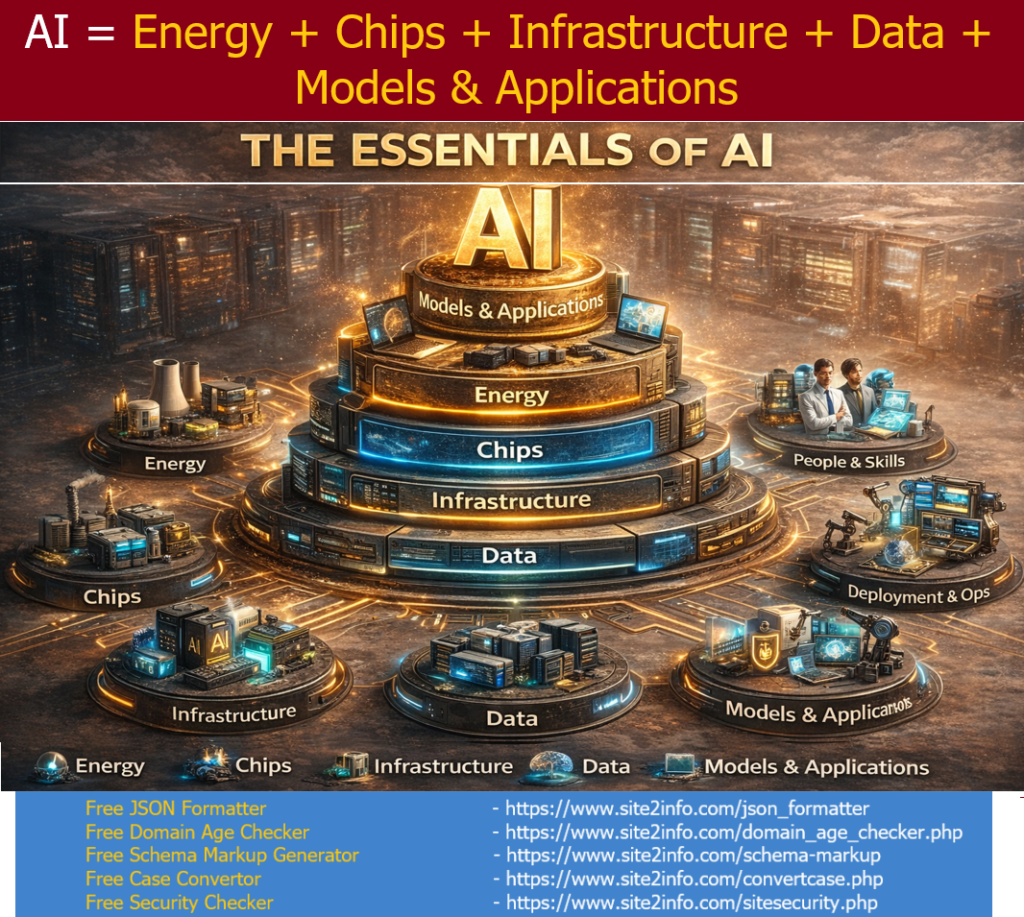
The Complete AI Essentials Framework

Artificial Intelligence is often discussed as if it were just about models—LLMs, copilots, or generative tools.
In reality, AI is a full-stack system that depends on multiple interconnected layers working together.

Understanding these layers is critical for leaders, architects, and decision-makers who want to build real, scalable AI, not just experiments.

Below is a complete AI Essentials framework, explained from the ground up.


1️⃣ Energy (The Foundational Layer)

AI is fundamentally power-hungry.

Training and running AI models require massive amounts of electricity, primarily consumed by data centers. Beyond raw power, cooling has become a major challenge—using air, water, and increasingly liquid cooling techniques. Energy efficiency and sustainability are now strategic concerns, not optional optimizations.

No power → no AI.

Without reliable, scalable energy, AI systems simply cannot exist.


2️⃣ Chips / Compute (The AI Engine)

Compute is the engine that drives intelligence.

Modern AI workloads rely on:

  • GPUs, TPUs, and NPUs
  • Specialized AI accelerators
  • High-bandwidth memory (HBM)

These components determine how fast models train, how cheaply they run, and whether advanced AI use cases are even possible.

Models don’t run without silicon.


3️⃣ Infrastructure (AI Factories)

Infrastructure is the environment where AI operates at scale.

This includes:

  • Cloud and on-prem data centers
  • High-speed networking and interconnects
  • Scalable storage systems
  • Kubernetes and orchestration platforms

Infrastructure transforms raw compute into production-ready AI systems.

This is where scale happens.


4️⃣ Data (The Most Underrated—and Most Important Layer)

AI learns from data, not code.

The quality of AI output depends on:

  • High-quality training data
  • Accurate labeling and enrichment
  • Robust data pipelines and governance
  • Data freshness and bias control

Even the most advanced model will fail if trained on poor or biased data.

Bad data → bad AI (no exceptions).


5️⃣ Models (The Intelligence Layer)

Models provide the reasoning capability.

This layer includes:

  • Foundation models (LLMs, multimodal models)
  • Domain-specific models
  • Fine-tuning and Retrieval-Augmented Generation (RAG)
  • Continuous evaluation and benchmarking

Models alone are not intelligence—they require context, data, and feedback.

Models without context are useless.


6️⃣ Applications (The Value Layer)

Applications are where AI delivers real-world impact.

This includes:

  • Copilots and assistants
  • Automation and intelligent agents
  • Industry-specific use cases
  • Seamless UX and workflow integration

If AI doesn’t improve productivity, decisions, or outcomes, it has no business value.

AI value is realized only here.


7️⃣ People & Skills (The Human Multiplier)

AI systems don’t build or manage themselves.

Successful AI programs require:

  • AI and ML engineers
  • Data scientists
  • Prompt engineers
  • Domain experts

Talent multiplies the value of every other AI layer.

People turn technology into outcomes.


8️⃣ Security, Ethics & Governance (The Trust Layer)

At scale, governance is non-negotiable.

This includes:

  • Model security and data privacy
  • Bias and fairness controls
  • Regulatory compliance
  • Human-in-the-loop oversight

Without governance, AI becomes a risk, not an asset.

Un-governed AI is a liability.


9️⃣ Deployment, MLOps & Monitoring (The Living System)

AI is never “done.”

Production AI requires:

  • CI/CD pipelines for models
  • Drift detection and retraining
  • Cost and performance monitoring
  • Continuous feedback loops

Unlike traditional software, AI systems evolve over time.

Production AI is a living system.

AI = Energy + Chips + Infrastructure + Data + Models + Applications + People + Governance + Operations

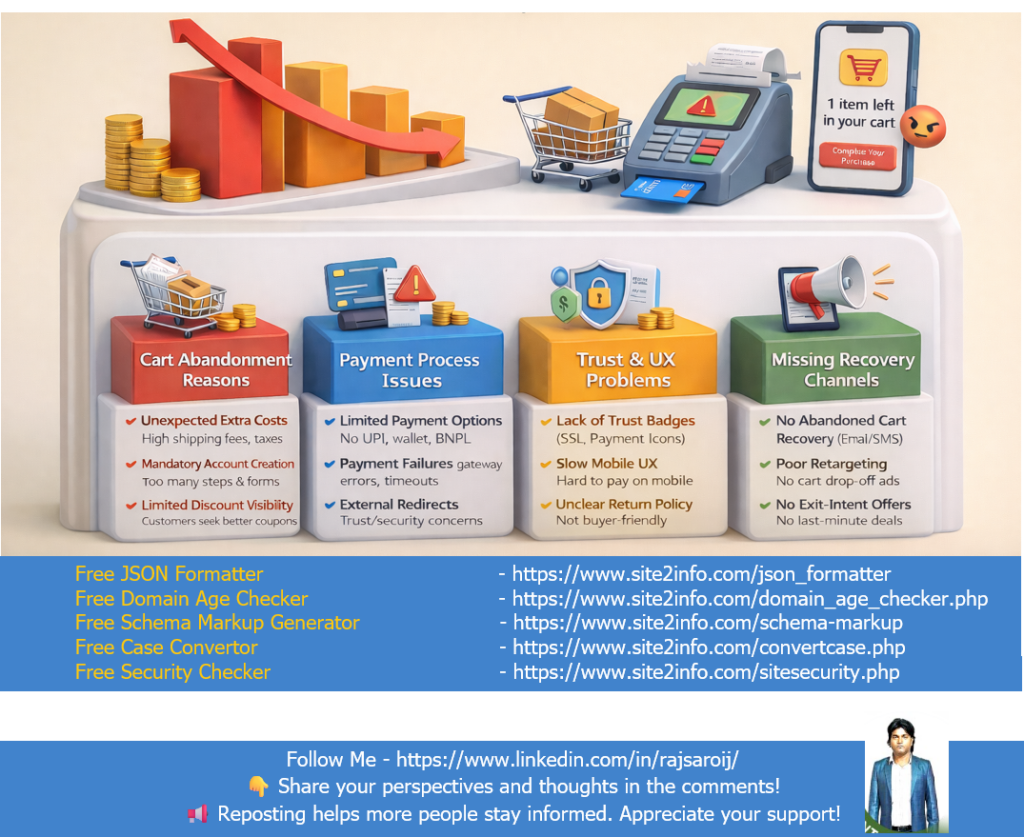
Why eCommerce Sales Decline – Cart Abandonment & Poor Payment

Ecommerce Sales Decline – (Cart Abandonment & Poor Payment Experience as Key Drivers)

🛒 Cart Abandonment–Related Reasons

  1. Unexpected Extra Costs
    – High shipping fees, taxes, or hidden charges shown at checkout
  2. Mandatory Account Creation
    – No guest checkout option
  3. Complex or Lengthy Checkout Process
    – Too many steps, forms, or unnecessary fields
  4. Lack of Price Transparency
    – Final amount differs from product page pricing
  5. Slow Page Load at Checkout
    – Especially on mobile networks
  6. No Cart Persistence
    – Cart resets after refresh or login
  7. Limited Discount / Coupon Visibility
    – Customers leave to search for better deals

💳 Payment Process–Related Reasons

  1. Limited Payment Options
    – Missing UPI, wallets, BNPL, COD, EMI, or local methods
  2. Payment Gateway Failures
    – Frequent transaction errors or timeouts
  3. Poor Mobile Payment Experience
    – Payment pages not optimized for mobile
  4. Redirection to External Payment Pages
    – Creates trust and security concerns
  5. No Saved Payment Options
    – Repeated manual entry discourages repeat buyers
  6. High Payment Failure Rate
    – Especially during peak sale hours

🔐 Trust & Security Issues

  1. Lack of Trust Badges / SSL Indicators
  2. Unclear Refund & Cancellation Policy
  3. No COD Option for First-Time Buyers

📦 Shipping & Delivery Issues

  1. Long or Uncertain Delivery Timelines
  2. No Real-Time Shipping Cost Estimation
  3. Limited Delivery Coverage / Pincode Issues

📱 UX & Performance Problems

  1. Poor Mobile UX (Buttons, Forms, Layout)
  2. Confusing CTA (“Proceed”, “Continue”, etc.)
  3. Broken Coupon or Promo Code Logic

📊 Marketing & Recovery Gaps

  1. No Abandoned Cart Recovery (Email/SMS/WhatsApp)
  2. No Exit-Intent Offers
  3. No Retargeting Ads for Cart Drop-Off Users

How to Fix & Boost Sales

✔ Simplify checkout (1–2 steps max)
✔ Offer guest checkout
✔ Add multiple local payment options
✔ Improve payment gateway reliability
✔ Optimize checkout for mobile
✔ Enable abandoned cart recovery
✔ Be transparent with pricing & delivery

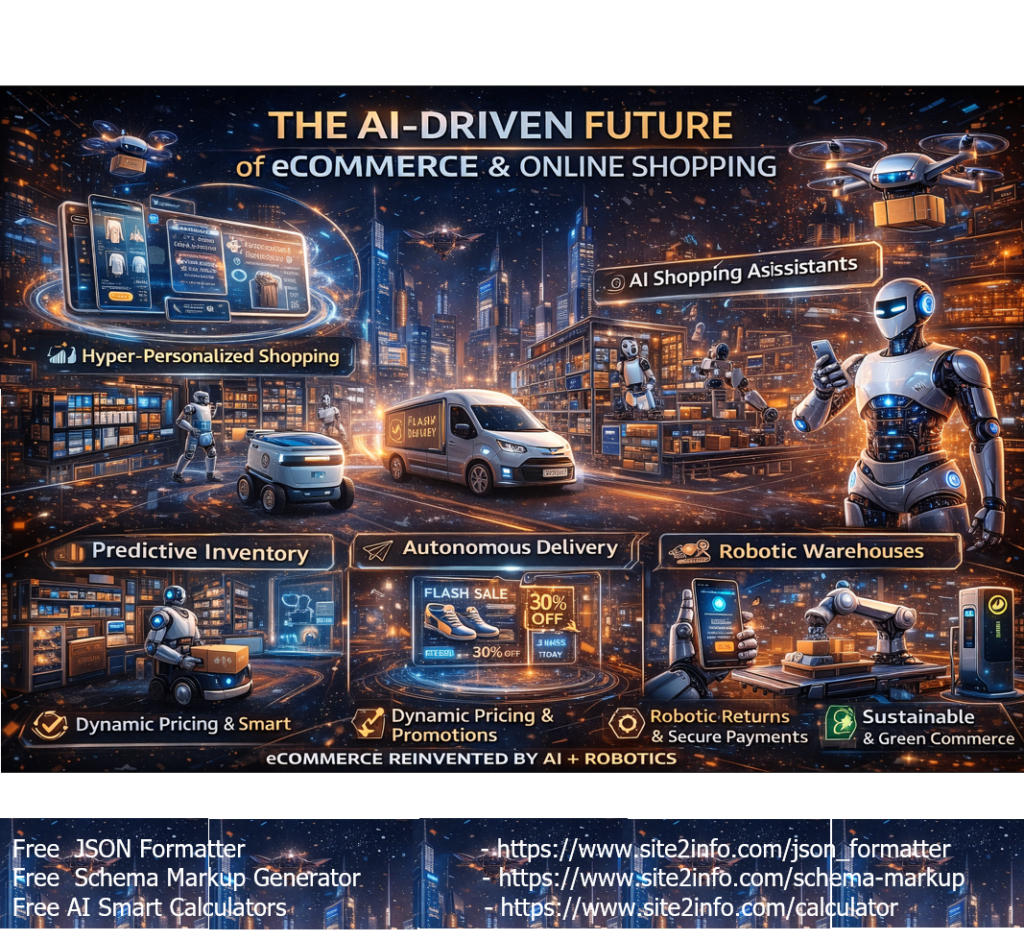
AI-Driven Future of eCommerce & Online Shopping

1️⃣ Hyper-Personalized Shopping (AI Brains)

AI will understand customers better than search filters ever could.

  • Predicts what you want before you search
  • Personalized homepages, pricing, offers, and bundles
  • Voice + chat shopping (“Order my usual groceries”)

Example:
AI suggests a complete outfit based on your past purchases, weather, and upcoming events.


2️⃣ AI Shopping Assistants & Virtual Sales Reps

Human-like AI assistants will replace basic customer support.

  • 24×7 conversational shopping
  • Size, style, compatibility guidance
  • Post-purchase support & returns handling

Example:
An AI assistant helps you compare phones, explains features, and checks delivery timelines instantly.


3️⃣ Robotic Warehouses (Dark Stores)

Warehouses will be fully automated.

  • Robots pick, pack, and sort orders
  • AI optimizes inventory placement
  • Zero human error, faster fulfillment

Example:
Amazon-style fulfillment centers where robots move shelves to packing stations.


4️⃣ Autonomous Delivery (Robots, Drones & EVs)

Last-mile delivery will be robotic-first.

  • Sidewalk delivery robots
  • Drone delivery for small items
  • Autonomous electric vans for cities

Example:
A delivery robot drops groceries outside your apartment within 15 minutes.


5️⃣ Predictive Inventory & Zero Stockouts

AI will forecast demand with high accuracy.

  • Predicts what will sell, where, and when
  • Auto-replenishment
  • Less overstock, less waste

Example:
AI predicts festival demand and stocks warehouses weeks in advance.


6️⃣ Dynamic Pricing & Smart Promotions

Prices will change in real time.

  • Based on demand, supply, competition
  • Personalized discounts
  • AI-controlled flash sales

Example:
You see a better price because AI knows you’re a repeat buyer.


7️⃣ Computer Vision & AR Shopping

Shopping will be visual, not textual.

  • Try clothes virtually
  • See furniture in your room (AR)
  • Scan products to reorder

Example:
Use your phone camera to see how a sofa fits in your living room.


8️⃣ Robotic Returns & Reverse Logistics

Returns will be automated too.

  • AI checks product condition via vision
  • Robots restock items
  • Faster refunds

Example:
Returned shoes are scanned, graded, and restocked automatically.


9️⃣ Fraud Detection & Secure Payments

AI will guard transactions.

  • Detect fake orders & bots
  • Behavioral fraud detection
  • Biometric & voice payments

Example:
AI blocks a suspicious payment instantly without OTP hassle.


🔟 Sustainable & Green Commerce

AI + Robotics will reduce carbon footprint.

  • Optimized delivery routes
  • Electric robots & vehicles
  • Reduced waste via demand prediction

Example:
AI consolidates deliveries to reduce emissions.

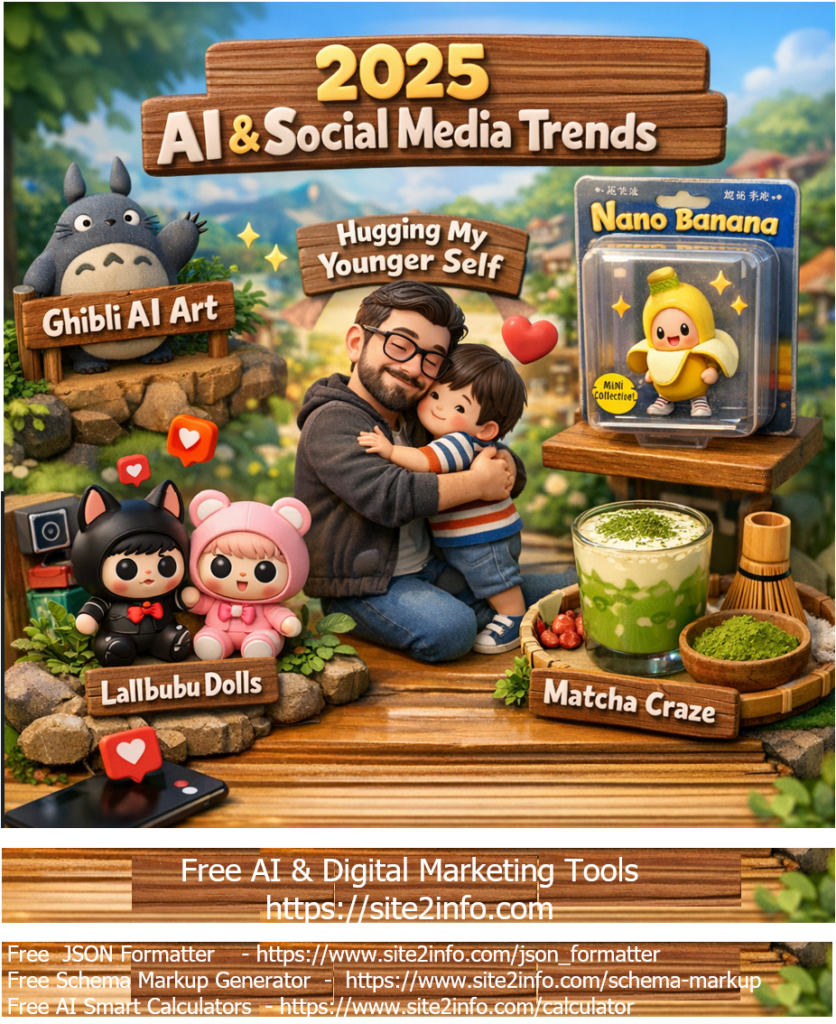
2025 AI & Social Media Trends That Defined the Internet

2025 AI & Social Media trend breakdown based on the biggest viral moments of the year as =

Ghibli-Style AI Art

What it was: A massive creative trend where users used AI tools to generate images in a Studio Ghibli-inspired animation style — soft colors, whimsical scenery and character art.
Why it trended: AI image generators like ChatGPT/GPT-4o made it easy to create beautiful, nostalgic art instantly, and people flooded social feeds with these stylised scenes.

Nano Banana (AI Figurine Trend)

What it was: A viral trend where AI (especially Google’s Gemini 2.5 Flash Image tool) turned simple photos into miniature, hyper-realistic 3D figurine images (often looking like collectible toys with realistic lighting/packaging).
How people used it: Creators showcased themselves, pets and celebs as digital action figures — blending creativity with shareable visuals.

“Hugging My Younger Self” – Gemini AI Nostalgia

What it was: Powered by Gemini AI, this trend let users generate photos where their present self appears hugging their childhood self.
Why it mattered: Emotional, reflective content spread widely as people shared nostalgic memories and self-care messages, blending AI tech with personal storytelling.

Lalbubu Dolls

What it was: A creepy-cute designer toy craze that exploded on social media — think wide eyes, big head, quirky expressions.
How it blew up: Gen Z creators turned Lalbubu dolls into cultural symbols, styling them in fashion reels, lifestyle shots and aesthetic videos. Resale prices soared and celebrities even shared their own Lalbubu posts.

Matcha Tea (Viral Lifestyle Trend)

What it was: Matcha shifted from just a wellness drink into a major social aesthetic food trend. Videos of bright green matcha, café pours, and home routines dominated short-form platforms.
Why it resonated: Beyond taste, matcha became a symbol of “calm productivity” and self-care rituals — perfect for visually appealing IG reels and TikTok content.