Top 10 Salary Negotiation Tips to Use in (Online & Offline Interviews)

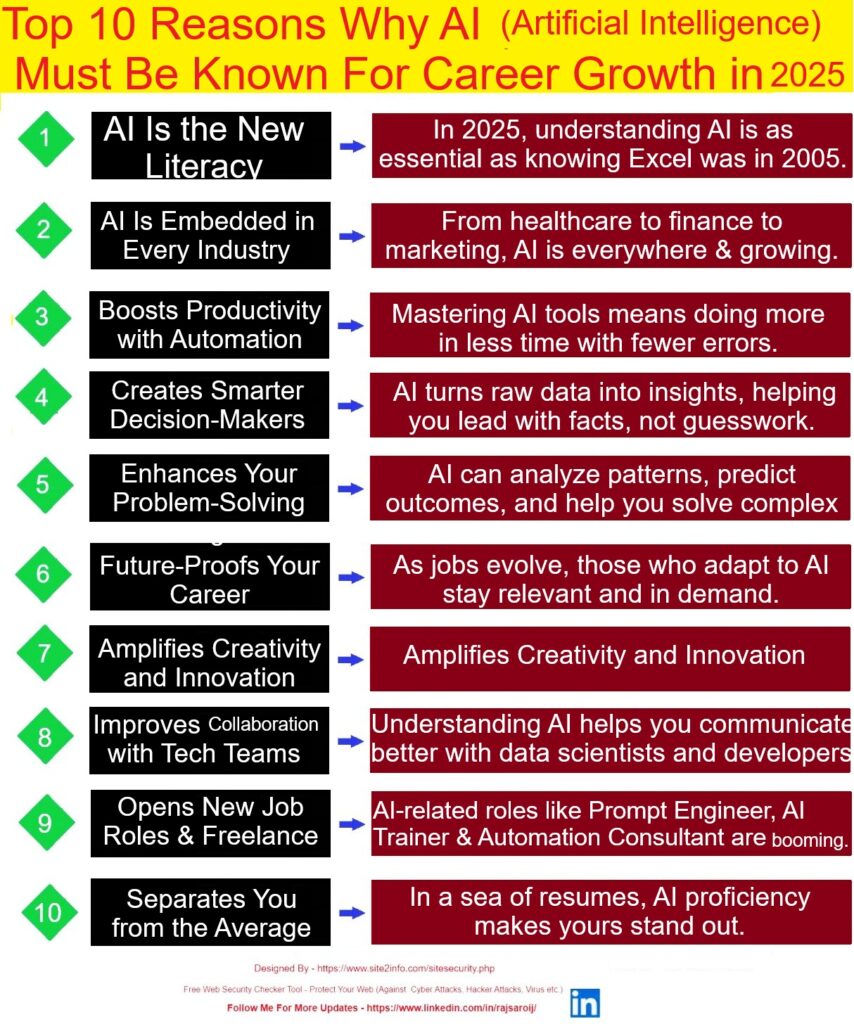
Top 10 Salary Negotiation Tips (Online & Offline Interviews)

Salary negotiation isn’t about being difficult — it’s about aligning your value with the right opportunity. Preparation, professionalism, and confidence are your greatest tools.

Salary negotiation isn’t awkward — it’s essential.
Whether you’re interviewing virtually or in person, here are 10 powerful tips to help you secure the pay you deserve:


Step [1] – Know Your Market Value
Before entering any negotiation, research industry benchmarks for your role, experience level, and location. Tools like Glassdoor, Payscale, or LinkedIn Salary can give you realistic expectations — empowering you to negotiate from a position of knowledge.

Step [2] – Let the Employer Go First
Avoid being the first to mention numbers. Let the employer share their offer first — it sets the starting point and gives you leverage to respond thoughtfully based on their expectations.

Step [3] – Don’t Undersell Yourself
Phrases like “I’m open to anything” or “Whatever works for you” weaken your perceived value. Be prepared with a confident salary range based on your market research and experience.

Step [4] – Be Confident, Not Pushy
Confidence shows that you know your worth. However, balance it with professionalism — being aggressive or entitled can create discomfort and harm your chances.

Step [5] – Quantify Your Achievements
Support your salary request with data and real outcomes — like “I increased revenue by 20%” or “Led a project that saved the company $30,000.” Numbers speak louder than opinions.

Step [6] – Consider Total Compensation
Salary is just one part of the package. Take into account benefits like health insurance, paid time off, bonuses, remote work, and equity — all of which contribute to the true value of an offer.

Step [7] – Prepare Your Talking Points
Rehearse how you’ll communicate your expectations and value. Have clear reasoning ready so you can respond with confidence when the salary question comes up.

Step [8] – Listen Actively
Good negotiators don’t just talk — they listen. Pay attention to what the employer is offering and why. This helps you respond strategically, rather than react emotionally.

Step [9] – Stay Professional if Rejected
If the employer declines your counteroffer, don’t burn bridges. Stay gracious and open — you might receive a revised offer or be considered for future opportunities.

Step [10] – Ask for Time to Decide
Don’t rush your decision. Request 24–48 hours to review the offer in full. This shows maturity and ensures you’re making a well-informed choice.
Why Office Politics Matter, It is Inevitable or Avoidable?

Why Office Politics Matter

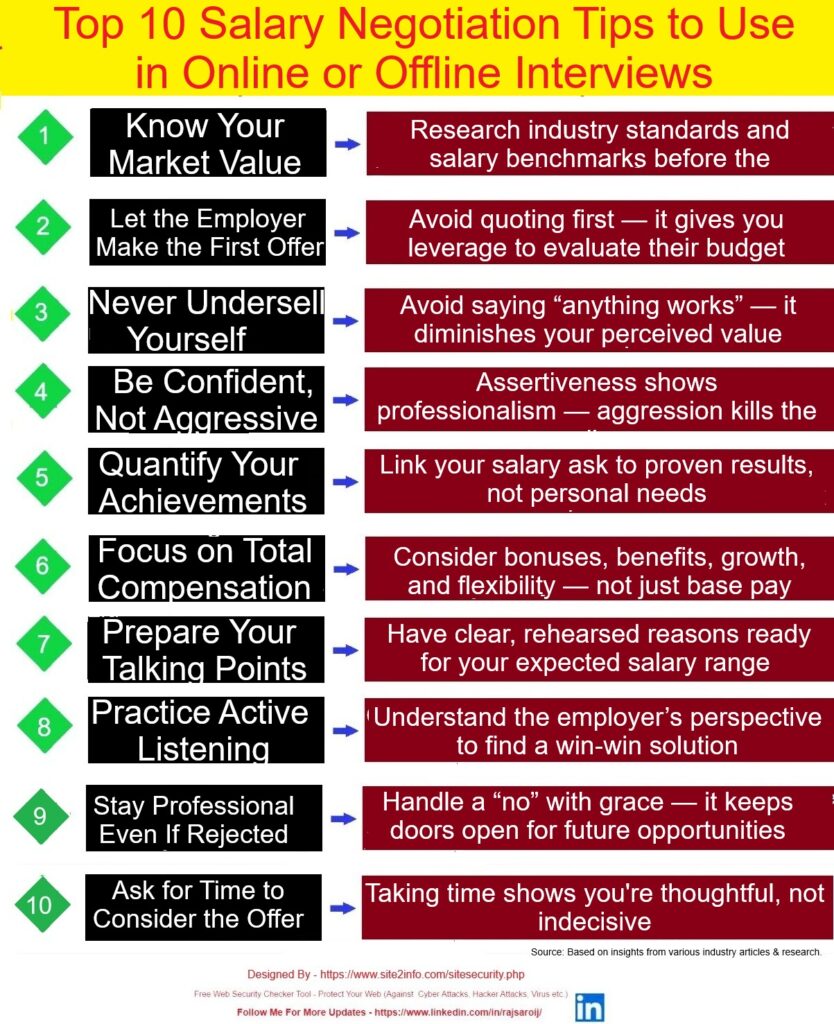
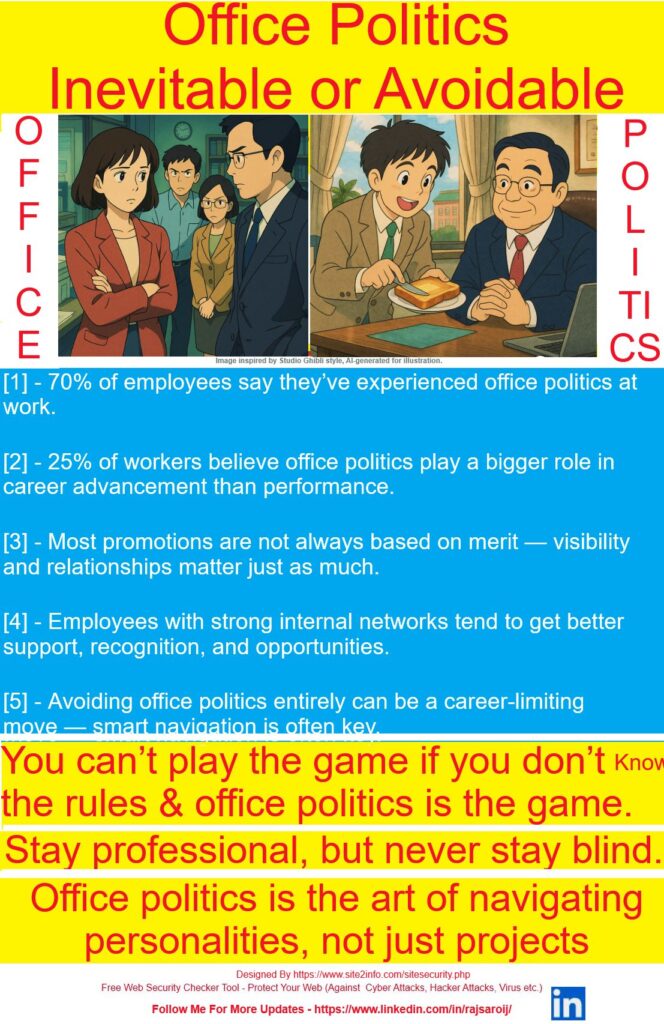
Office politics are often unavoidable, and in many cases, necessary to succeed in complex team environments. Knowing how to manage relationships, build alliances, and position yourself professionally can have as much impact as your job performance.

Office Politics: Inevitable or Avoidable?

Office politics often gets a bad reputation — but the truth is, it’s not always toxic. Sometimes, it’s simply the natural result of human relationships, influence, and informal dynamics within the workplace.

Understanding it doesn’t mean playing dirty — it means navigating with awareness, strategy, and emotional intelligence.

Interesting Facts About Office Politics

70% of employees say they’ve experienced office politics at work
1 in 4 workers believe office politics has more impact on promotions than performance
✅ Promotions often hinge on visibility and relationships, not just merit
✅ Employees with strong internal networks get more recognition, support, and growth opportunities
✅ Avoiding politics entirely can actually limit career advancement

You don’t have to play dirty — but you do have to play smart.
Office politics isn’t about manipulation — it’s about connection, visibility, and strategic awareness.

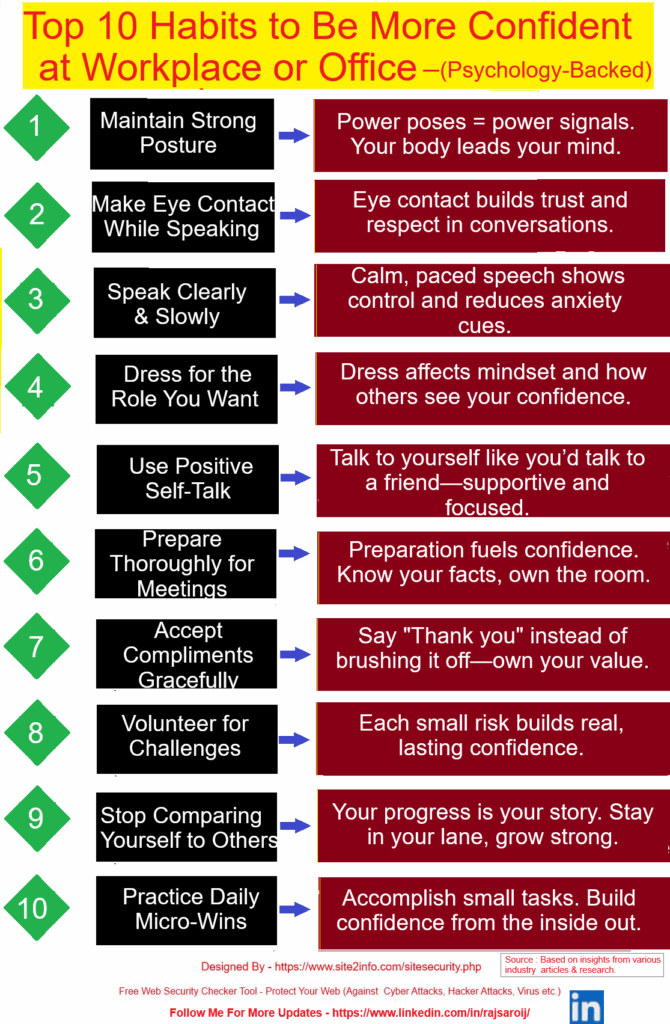
Top 10 Habits to Be More Confident at Workplace or Office

Confidence isn’t a gift. It’s a habit.

Confidence isn’t a trait — it’s your daily training.

Want to appear more self-assured, respected, and impactful at your workplace?

Here are 10 habits to level up your confidence at work

Step [1] . Stand Tall, Sit Straight

🧍‍♂️ Good posture changes how you feel and how others see you.

A straight back, relaxed shoulders, and a firm stance subconsciously signal strength and readiness. Posture is the body’s confidence amplifier.

Step – [2]. Make Eye Contact

👀 Don’t stare — just connect. It builds trust instantly.

Looking people in the eye while speaking shows you’re grounded, present, and open. It’s a silent way to project inner certainty.

Step – [3]. Speak Slowly, With Intent

🗣️ Fast = nervous. Calm and steady = confident and in control.

Slow, deliberate speech commands attention. It tells others (and yourself) that what you’re saying matters.

Step – [4]. Dress Sharp, Feel Sharp

👔 Style impacts psychology. Dress for the role you aspire to.

When you dress well, you carry yourself differently. You send a silent message: “I belong here.”

Step – [5]. Talk Kindly to Yourself

🧠 Replace “I’m not ready” with “I’m learning and growing.”

Inner dialogue drives outward behavior. Positive self-talk strengthens self-worth and resilience over time.

Step – [6]. Prepare, Don’t Wing It

📑 Confidence is earned behind the scenes through preparation.

Rehearsing, researching, and knowing your material quiets the inner critic and builds natural self-assurance.

Step – [7]. Receive Compliments Without Shrinking

🙏 A simple “thank you” is powerful. Don’t deflect — own your wins.

Brushing off praise may feel humble, but accepting it with grace reinforces your value — for you and others.

Step – [8]. Say Yes to Stretch Goals

🚀 Step out of comfort. Each challenge conquered = confidence built.

Growth lies just beyond “I’m not sure I can.” Say yes, show up, figure it out — that’s how self-belief is built.

Step – [9]. Focus on Progress, Not Comparison

🔍 Comparison kills joy. Track your growth — not others’.

Everyone’s journey is different. Confidence grows when you celebrate your own milestones, not someone else’s finish line.

Step – [10]. Stack Small Wins Daily

Micro-success fuels macro-confidence. Do one thing well every day.

Consistency is the quiet engine of confidence. Small daily actions build momentum — and belief.

Top 10 Reasons Why AI Must Be Known for Career Growth in 2025

The following below are the Top 10 Reasons Why AI Must Be Known for Career Growth in 2025 — tailored for a tech-forward, future-ready professional

Step [1] – AI Is the New Literacy

– In 2025, understanding AI is as essential as knowing Excel was in 2005.

Step [2] – AI Is Embedded in Every Industry

– From healthcare to finance to marketing, AI is everywhere—and growing.

Step [3] – Boosts Productivity with Automation

– Mastering AI tools means doing more in less time with fewer errors.

Step [4] – Creates Smarter Decision-Makers

– AI turns raw data into insights, helping you lead with facts, not guesswork.

Step [5] – Future-Proofs Your Career

– AI can analyze patterns, predict outcomes, and help you solve complex issues faster.

Step [6] – Enhances Your Problem-Solving Edge

– As jobs evolve, those who adapt to AI stay relevant and in demand.

Step [7] – Amplifies Creativity and Innovation

– AI helps generate content, design, and code—making you a creative powerhouse.

Step [8] – Improves Collaboration with Tech Teams

– Understanding AI helps you communicate better with data scientists and developers.

Step [9] – Opens New Job Roles & Freelance Gigs

– AI-related roles like Prompt Engineer, AI Trainer, and Automation Consultant are booming.

Step [10] – Separates You from the Average

– In a sea of resumes, AI proficiency makes yours stand out.