Define Project Management Life Cycle

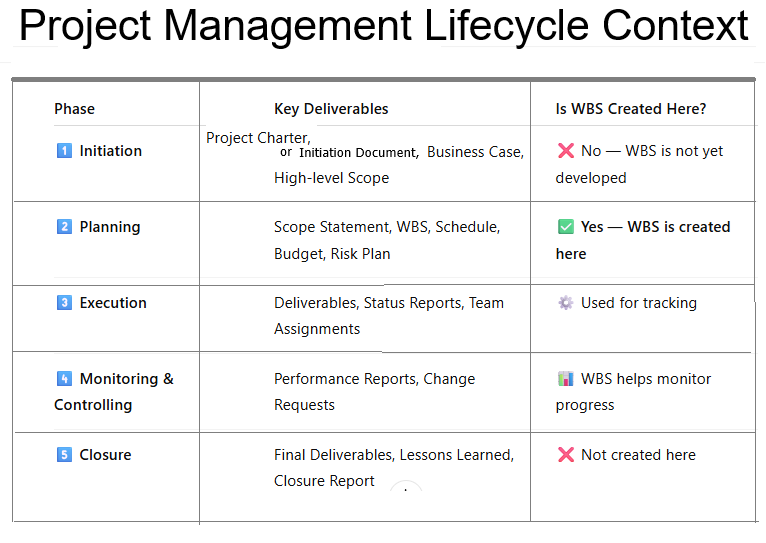
These are the 5 Project Management Process Groups defined by PMI (Project Management Institute) in the PMBOK (Project Management Body of Knowledge).

These are NOT SDLC phases — they are Project Management Phases used in any type of project, including IT, software, construction, and business operations.


1️⃣ Initiation Phase

Purpose: Start the project formally
Activities include:

  • Define project goals
  • Create Project Charter
  • Identify stakeholders
  • High-level scope & feasibility

2️⃣ Planning Phase

Purpose: Plan how the project will be executed
Activities include:

  • Detailed project plan
  • Scope planning
  • Schedule & timeline
  • Budget planning
  • Risk management plan
  • Resource planning
  • Communication plan

3️⃣ Execution Phase

Purpose: Do the actual work
Activities include:

  • Team execution
  • Development, design, testing
  • Managing stakeholders
  • Quality management
  • Task assignments
  • Delivering project outputs

4️⃣ Monitoring & Controlling Phase

Purpose: Track progress and control deviations
Activities include:

  • Monitor KPIs
  • Control scope changes
  • Track timeline and budget
  • Ensure quality standards
  • Issue/risk management
  • Status reporting

5️⃣ Closure Phase

Purpose: Formally end the project
Activities include:

  • Final deliverables
  • Approvals and sign-off
  • Documentation
  • Lessons learned
  • Release resources
  • Project completion report

Explain all SDLC Methodologies or SDLC Models

SDLC (Software Development Life Cycle) methodologies are structured frameworks used to plan, design, build, test, and maintain software

 It breaks down the complex process into distinct phases, providing a framework that helps manage time, resources, and risks throughout the development of a software product.

Types of SDLC Methodologies or SDLC Models

1️⃣ Waterfall Model

A linear and sequential development model where each phase must be completed before moving to the next.

Key Features:

  • Requirements → Design → Development → Testing → Deployment → Maintenance
  • No going back to previous phases
  • Best for projects with clear, fixed requirements

Used In:

Government, manufacturing, construction, highly controlled environments.


2️⃣ Iterative Model

The product is built step-by-step in small cycles, with feedback after each iteration.

Key Features:

  • Build → Test → Improve → Repeat
  • Each version is better than the previous
  • Reduces risk early
  • Good when complete requirements are not known initially

Used In:

Prototyping, early-stage product development, systems requiring gradual evolution.


3️⃣ Spiral Model

A risk-driven software development model combining Waterfall + Iterative + Risk Management.

Key Features:

  • Each spiral = Planning → Risk Analysis → Engineering → Evaluation
  • Focuses on risk reduction
  • Excellent for large, complex, high-risk projects

Used In:

Defense, aerospace, expensive systems where failure is costly.


4️⃣ V-Model (Verification & Validation Model)

A “V-shaped” model where testing activities happen in parallel with development phases.

Key Features:

  • Each development phase has a corresponding testing phase
  • Very structured and strict
  • Great for systems requiring validation & compliance

Used In:

Healthcare, automotive, safety-critical software, regulated industries.


5️⃣ Big Bang Model

Little to no planning — development starts immediately and evolves as needed.

Key Features:

  • No formal process
  • Suitable only for small, experimental, or short projects
  • Very high risk and unpredictable

Used In:

POCs, experiments, small teams building quick concepts.


6️⃣ Agile Model

An adaptive, flexible, iterative model where development happens in small increments (Sprints).

Key Features:

  • Continuous improvement
  • Responding to change over following a strict plan
  • Customer involvement at every step
  • Works in Sprints (Scrum) or flows (Kanban)

Used In:

Modern software development, ecommerce, SaaS, mobile apps, startups.

📌 Are these the only SDLC models?

No — but they are the most standard and widely used models.

Other recognized SDLC approaches include:

  • Incremental Model
  • Prototype Model
  • RAD (Rapid Application Development) Model
  • DevOps Model
  • Hybrid Model (Agile + Waterfall)
  • Scrum Framework (under Agile)
  • Kanban (under Agile)

But the core SDLC models (commonly taught and used) are exactly the ones you included.

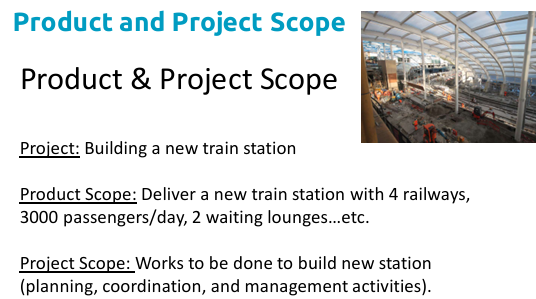
Difference Between Project Scope and Product Scope

1. Product Scope

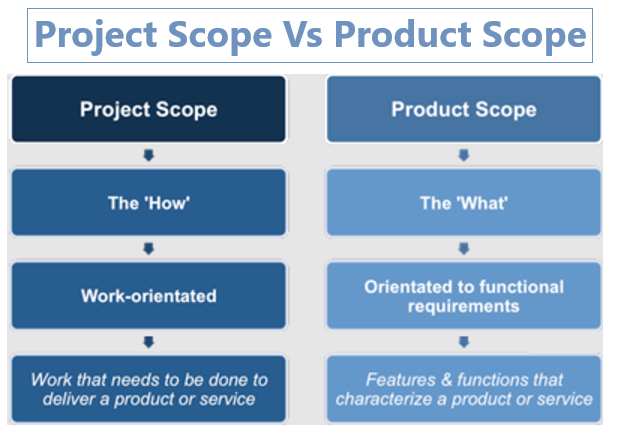
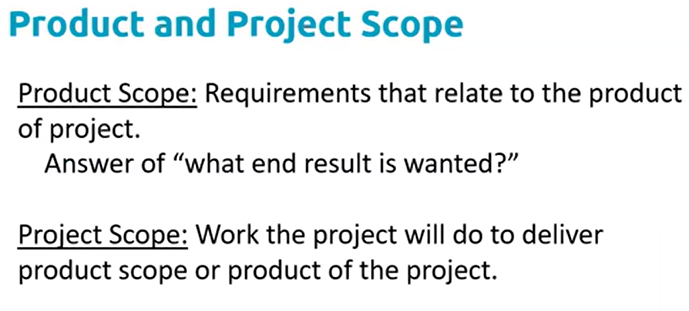
The product scope defines the features, functionalities, and characteristics of the final product or deliverable that the project is meant to create. It answers the “what” question: What does the product include?

Product Scope: Focuses on what the product will be (the end result)

Features of Product Scope:

  • Focus: On the product itself.
  • Defined By:
    • Functional requirements (e.g., “The website must support online payments”).
    • Non-functional requirements (e.g., “The app must load within 3 seconds”).
    • Features, quality, and performance criteria.
  • Validation: Measured by whether the product meets the specified requirements (e.g., user acceptance testing, feature testing).

Example of Product Scope

For an e-commerce website project:

  • Product Scope Includes:
    • A fully functional website with online payment capability.
    • A product search feature.
    • Integration with an inventory management system.

2. Project Scope

The project scope defines all the work required to deliver the product. It focuses on the “how” question: How will the product be delivered?

Project Scope: Focuses on how the product will be created (the process).

Features of Project Scope:

  • Focus: On the work and processes involved in creating the product.
  • Defined By:
    • Activities, tasks, and deliverables needed to complete the project.
    • Resource allocation, timelines, and constraints.
    • Processes for risk management, quality assurance, and communication.
  • Validation: Measured by whether the project achieves its objectives on time and within budget (e.g., project completion review).

Example of Project Scope

For the e-commerce website project:

  • Project Scope Includes:
    • Designing the website layout.
    • Developing the payment integration.
    • Testing the website functionality.
    • Deploying the website on a server.
    • Training staff to manage the website.

Combined Example of Project Scope & Product Scope