| BRD | FRD / FRS | SRS | |
| Scope | Project Objective, Project Scope, Stakeholders, Success Criteria It depends on WHAT & WHY Project | All Detailed Granular Functional Requirement as form UML & Data Flow Diagram | Project’s All Functional & Non Functional Requirement Security, Performance, Reliability, Scalability Availability |
| Created By | Business Analyst | Functional Analyst | Business Analyst |
| Focus | What & Why Project is going to be created | Defines How the system will work to meet those business needs. | detailed document (functional and non-functional )requirements & providing a final or comprehensive blueprint of the system |
| Audience | Business Analyst, Stakeholders, Project /Product Managers | Development Team , QA Team, | Development Team , QA Team, |
| Prepared In | Initial Phase | Planning Phase | Planning Phase |
| Example | Need to improve customer experience through a new system | Users can register, search for products, and purchase online | The system must handle 1,000 users with no more than 2-second response time |
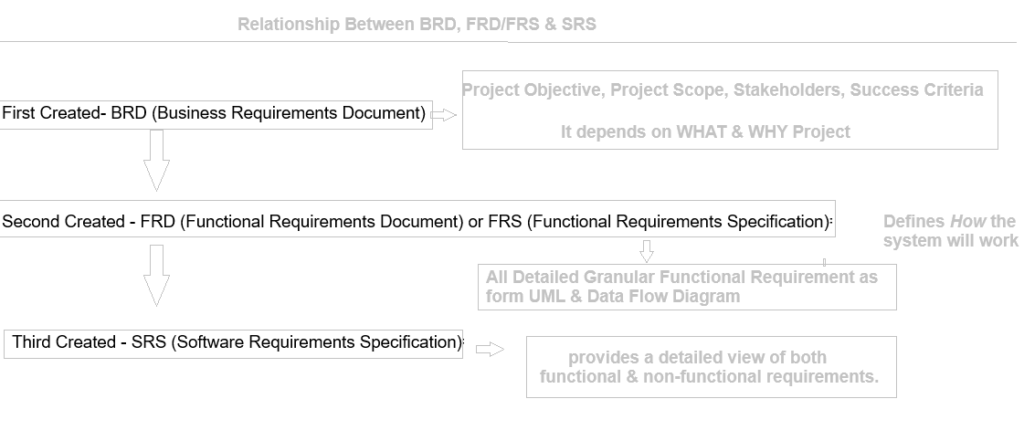
The Flow of BRD (Business Requirements Document) & FRD (Functional Requirements Document) or FRS (Functional Requirements Specification) & SRS (Software Requirements Specification)
First Created- BRD (Business Requirements Document)
Second Created – FRD (Functional Requirements Document) or FRS (Functional Requirements Specification)
Third Created – SRS (Software Requirements Specification)
Business Analyst Role: BRD vs FRD vs SRS
🔹 BRD – Business Requirements Document
Focus: Why to develop
Purpose:
- Captures the business problem, goals, and justification
- Explains why the project exists and what value it should deliver
- Written for business stakeholders, sponsors, leadership
Typical contents:
- Business objectives
- Problem statement
- Scope (in / out)
- High-level requirements
- Success metrics (KPIs)
- Assumptions & constraints
📌 BA Role:
Translate business needs into clear, measurable objectives.
🔹 FRD – Functional Requirements Document
Focus: What to develop
Purpose:
- Defines what the system should do to meet business needs
- Bridges business expectations and technical design
- Written for product owners, QA, and development teams
Typical contents:
- Functional workflows
- User stories / use cases
- Business rules
- Inputs & outputs
- Error handling & validations
📌 BA Role:
Break business goals into functional behaviors the system must support.
🔹 SRS – Software Requirements Specification
Focus: How to develop
Purpose:
- Describes how the system will be built from a technical perspective
- Acts as a blueprint for developers
- Written for developers, architects, and testers
Typical contents:
- System architecture
- Technical interfaces (APIs)
- Data models
- Performance, security, scalability requirements
- Non-functional requirements (NFRs)
📌 BA Role:
Support and validate technical requirements to ensure alignment with business intent (often co-owned with architects).