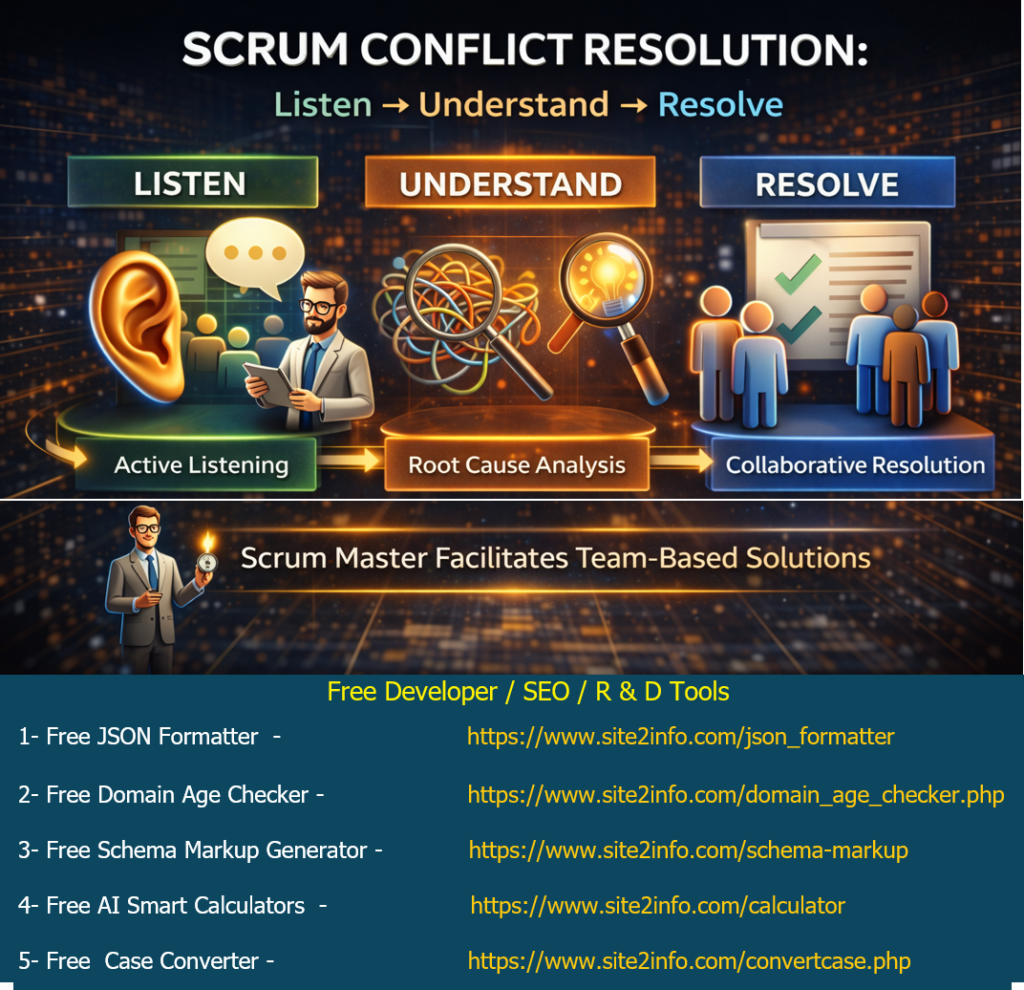
In Agile and Scrum environments, conflict is not a failure—it’s a signal. Diverse perspectives, fast-paced delivery, and cross-functional collaboration naturally create disagreements. What matters is how those conflicts are handled.
Scrum doesn’t prescribe a rigid conflict-resolution framework, but it strongly emphasizes servant leadership, transparency, and collaboration. A simple yet powerful approach that aligns well with Scrum values is:
Listen → Understand → Resolve
Why Conflict Happens in Scrum Teams
Common causes include:
- Different interpretations of requirements
- Priority or scope disagreements
- Technical vs business trade-offs
- Time pressure during sprints
- Personality or communication gaps
Handled poorly, conflict slows delivery.
Handled well, it strengthens trust and team maturity.
Step 1: Listen (Active Listening)
The first responsibility—often of the Scrum Master—is to create a safe space for dialogue.
✔ Listen without interrupting
✔ Acknowledge emotions as well as facts
✔ Avoid assumptions or early judgment
Scrum principle: Respect & openness
The goal is not to respond, but to understand.
Step 2: Understand (Root Cause Thinking)
Most conflicts are symptoms, not root problems.
Techniques to use:
- 5 Whys to identify the underlying issue
- Clarify assumptions and expectations
- Reframe the discussion around the Sprint Goal
✔ Is this a role clarity issue?
✔ A dependency problem?
✔ A priority misalignment?
Scrum principle: Focus on value and outcomes, not blame.
Step 3: Resolve (Collaborative Resolution)
Resolution in Scrum is not command-driven—it’s facilitated.
Effective practices:
- Encourage team-led solutions
- Timebox discussions to avoid over-analysis
- Align decisions with the Sprint Goal and Product Vision
- Seek consensus, not compromise
✔ The team owns the solution
✔ The Scrum Master guides the process
Scrum principle: Self-managing teams
Role of the Scrum Master in Conflict Resolution
The Scrum Master acts as a:
- Facilitator, not a judge
- Servant leader, not an enforcer
- Coach, not a decision-maker
Their success is measured by:
- Psychological safety
- Team trust
- Continuous improvement
One-Line Interview Answer
“In Scrum, I resolve conflicts through active listening, understanding the root cause, and facilitating a collaborative solution aligned with the sprint goal.”
Final Thought
Conflict in Scrum is inevitable—but unresolved conflict is optional.
By practicing Listen → Understand → Resolve, teams don’t just fix problems—they grow stronger, faster, and more resilient.