
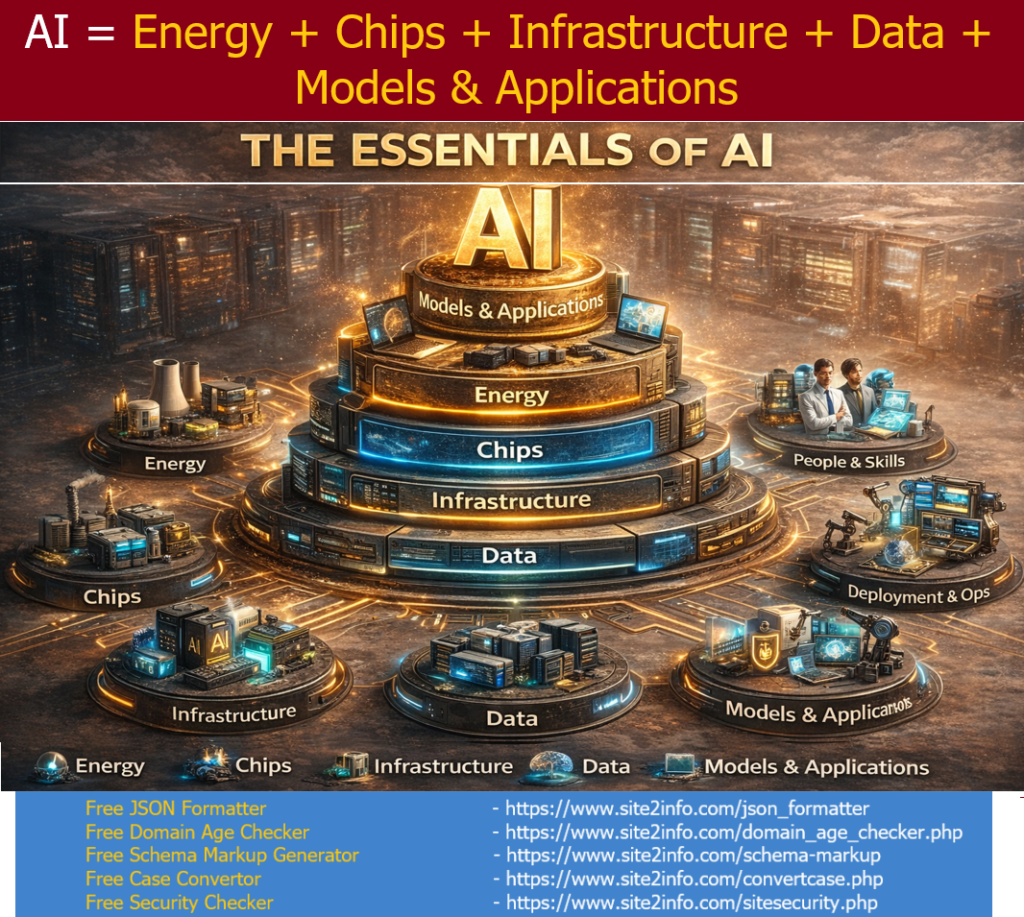
Artificial Intelligence is often discussed as if it were just about models—LLMs, copilots, or generative tools.
In reality, AI is a full-stack system that depends on multiple interconnected layers working together.
Understanding these layers is critical for leaders, architects, and decision-makers who want to build real, scalable AI, not just experiments.
Below is a complete AI Essentials framework, explained from the ground up.
1️⃣ Energy (The Foundational Layer)
AI is fundamentally power-hungry.
Training and running AI models require massive amounts of electricity, primarily consumed by data centers. Beyond raw power, cooling has become a major challenge—using air, water, and increasingly liquid cooling techniques. Energy efficiency and sustainability are now strategic concerns, not optional optimizations.
No power → no AI.
Without reliable, scalable energy, AI systems simply cannot exist.
2️⃣ Chips / Compute (The AI Engine)
Compute is the engine that drives intelligence.
Modern AI workloads rely on:
- GPUs, TPUs, and NPUs
- Specialized AI accelerators
- High-bandwidth memory (HBM)
These components determine how fast models train, how cheaply they run, and whether advanced AI use cases are even possible.
Models don’t run without silicon.
3️⃣ Infrastructure (AI Factories)
Infrastructure is the environment where AI operates at scale.
This includes:
- Cloud and on-prem data centers
- High-speed networking and interconnects
- Scalable storage systems
- Kubernetes and orchestration platforms
Infrastructure transforms raw compute into production-ready AI systems.
This is where scale happens.
4️⃣ Data (The Most Underrated—and Most Important Layer)
AI learns from data, not code.
The quality of AI output depends on:
- High-quality training data
- Accurate labeling and enrichment
- Robust data pipelines and governance
- Data freshness and bias control
Even the most advanced model will fail if trained on poor or biased data.
Bad data → bad AI (no exceptions).
5️⃣ Models (The Intelligence Layer)
Models provide the reasoning capability.
This layer includes:
- Foundation models (LLMs, multimodal models)
- Domain-specific models
- Fine-tuning and Retrieval-Augmented Generation (RAG)
- Continuous evaluation and benchmarking
Models alone are not intelligence—they require context, data, and feedback.
Models without context are useless.
6️⃣ Applications (The Value Layer)
Applications are where AI delivers real-world impact.
This includes:
- Copilots and assistants
- Automation and intelligent agents
- Industry-specific use cases
- Seamless UX and workflow integration
If AI doesn’t improve productivity, decisions, or outcomes, it has no business value.
AI value is realized only here.
7️⃣ People & Skills (The Human Multiplier)
AI systems don’t build or manage themselves.
Successful AI programs require:
- AI and ML engineers
- Data scientists
- Prompt engineers
- Domain experts
Talent multiplies the value of every other AI layer.
People turn technology into outcomes.
8️⃣ Security, Ethics & Governance (The Trust Layer)
At scale, governance is non-negotiable.
This includes:
- Model security and data privacy
- Bias and fairness controls
- Regulatory compliance
- Human-in-the-loop oversight
Without governance, AI becomes a risk, not an asset.
Un-governed AI is a liability.
9️⃣ Deployment, MLOps & Monitoring (The Living System)
AI is never “done.”
Production AI requires:
- CI/CD pipelines for models
- Drift detection and retraining
- Cost and performance monitoring
- Continuous feedback loops
Unlike traditional software, AI systems evolve over time.
Production AI is a living system.
AI = Energy + Chips + Infrastructure + Data + Models + Applications + People + Governance + Operations