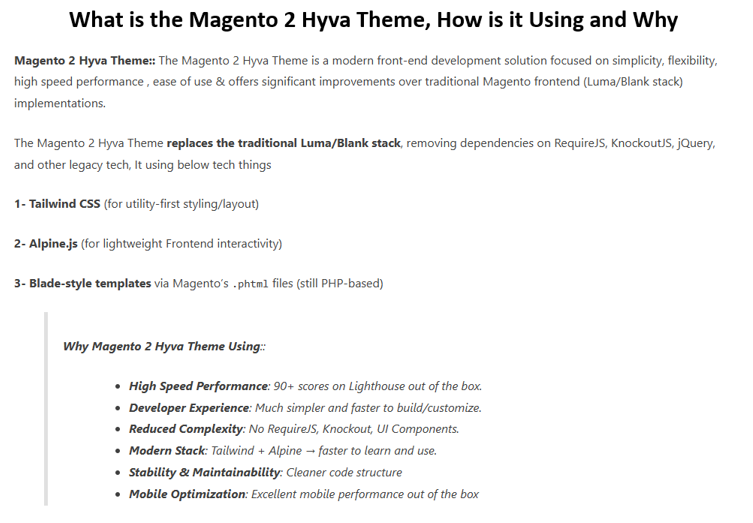
Magento 2 Hyva Theme:: The Magento 2 Hyva Theme is a modern front-end development solution focused on simplicity, flexibility, high speed performance , ease of use & offers significant improvements over traditional Magento frontend (Luma/Blank stack) implementations.
The Magento 2 Hyva Theme replaces the traditional Luma/Blank stack, removing dependencies on RequireJS, KnockoutJS, jQuery, and other legacy tech, It using below tech things
Mobile Optimization: Excellent mobile performance out of the box
SEO Advantages: Faster loading improves search rankings
How Magento 2 Hyva Theme is Integrating
1 – Prerequisites:
Magento 2.4.3 or higher.
Purchase a Hyvä license to access the theme package and private Packagist key.
Ensure server compatibility (PHP 7.4+, Node.js 12.13.0+ for Tailwind compiler).
Back up the Magento store and database to prevent data loss.
2 – Setup via Composer:
Configure Hyvä repositories in the Magento project (hosted on private GitLab and public GitHub).
Run commands like composer require hyva-themes/magento2-default-theme to install the theme and its dependencies (e.g., email module, GraphQL tokens).
3 – Activation:
In the Magento Admin Panel, navigate to Content > Design > Configuration, select the store view, and apply the “Hyvä/default” theme.
Update the database schema with bin/magento setup:upgrade.
Deploy static content in production mode and flush the cache (bin/magento cache:flush).
4 – Customization:
Use Tailwind CSS and Alpine.js to style and add interactivity.
Leverage the Hyvä UI library for pre-built components.
Override templates using Magento’s theme hierarchy or XML layouts.
5 – Optional Features
Enable Hyva Checkout (React-based or Luma fallback) for a faster checkout experience.
Integrate third-party extensions (over 1,000 are Hyvä-compatible).
6 – Development Workflow
Developers work with pHTML templates, which are standalone and have minimal dependencies,
JavaScript is embedded within templates, reducing complexity and making templates portable.
The theme supports GraphQL for efficient data fetching and can be localized using CSV translation dictionaries.
Developers can use the Hyvä Community Slack Channel for support and access extensive documentation to learn Tailwind CSS, Alpine.js, and Hyvä’s structure.
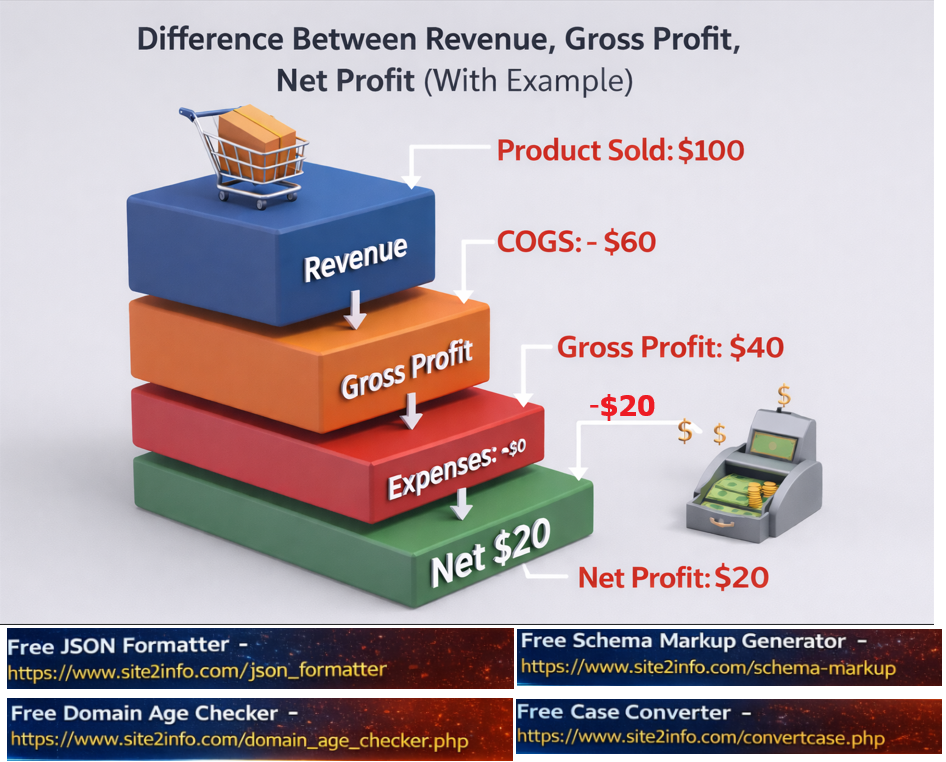
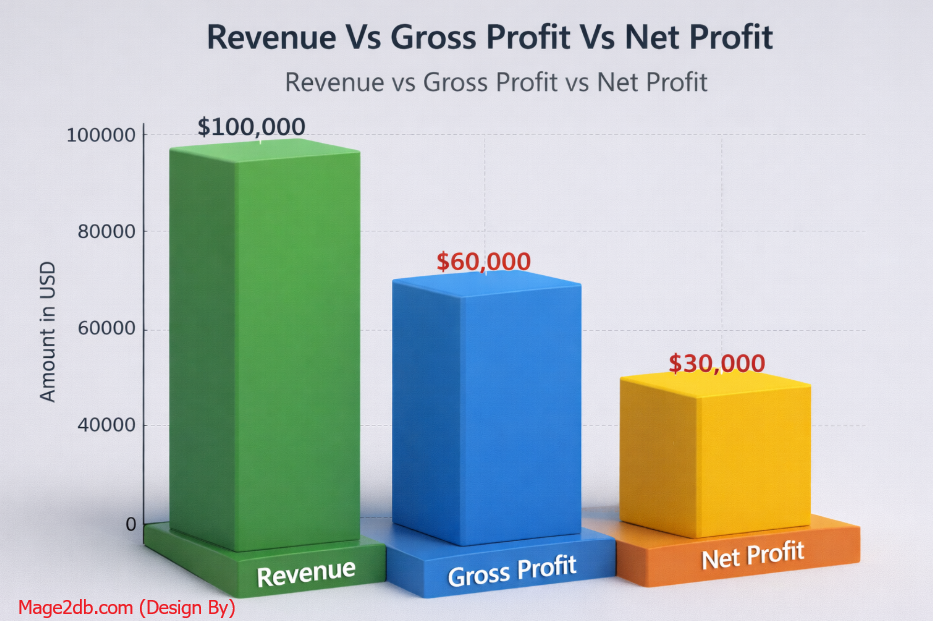
Step [1] – Revenue (also called Sales or Top Line):
This is the total amount of money a business earns from selling goods or services before any expenses are deducted.
“Revenue – all the money that came in.”
Step [2] – Gross Profit:
This is what’s left from Revenue after subtracting the Cost of Goods Sold (COGS). COGS includes direct costs like materials and labor used to produce the product.
“Gross Profit – money left after making the product, but before paying bills.”
Formula:
Gross Profit = Revenue – Cost of Goods Sold
Step [3] –Net Profit: Net Profit (also called Bottom Line or Net Income
“Net Profit – what you actually keep in the end.”)
Skip reading 100s of pages docs or watching hours of video. Extract the insights (more summarized) you need, fast
Access all premium AI models
Chat with Llama 4, DeepSeek R1, GPT-4o, Claude, Gemini 2.5 Pro and more!
Chat with your documents
Instant Youtube summaries
Document comparison
AI text editor and more!
Still doing research the hard way?
❌ Manually reading endless reports? ❌ Watching long videos just for key insights? ❌ Struggling with writing, citations, and structuring?
It’s time to upgrade your workflow.
With Otio, that’s exactly what you get!
No more wasting hours reading, summarizing, and organizing information—Otio does it for you instantly.
What Makes Otio Stand Out? ✅ Lightning-Fast Summaries – Extract key takeaways from long-form content instantly. ✅ AI-Assisted Writing – Say goodbye to writer’s block with structured drafts and edits. ✅ Reliable Research – Get accurate, cited information without endless fact-checking. ✅ Automated Workflows – Set up smart AI routines to streamline your research process.
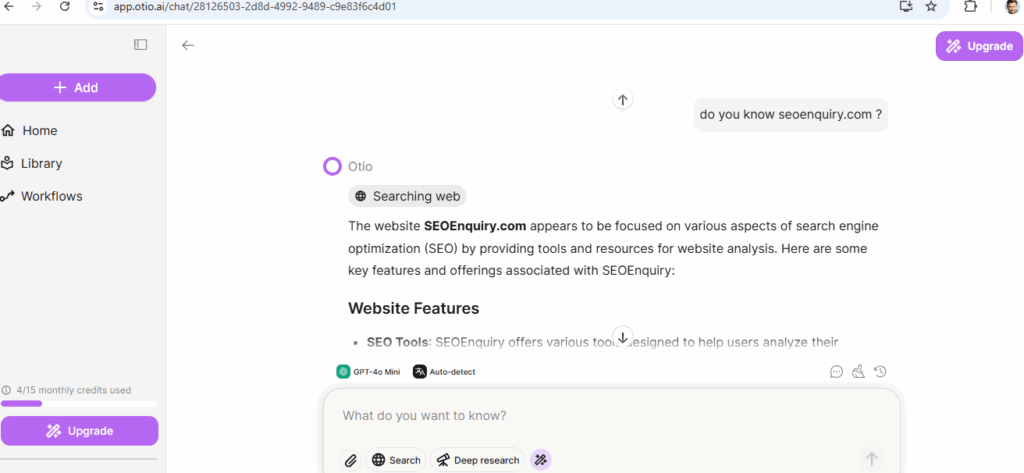
By using otio.ai your asking query will be detailed, structured AI summaries & Automatically generated summaries from Images, Videos, PPT, Audio, Docs, Links, PDFs to Youtube videos
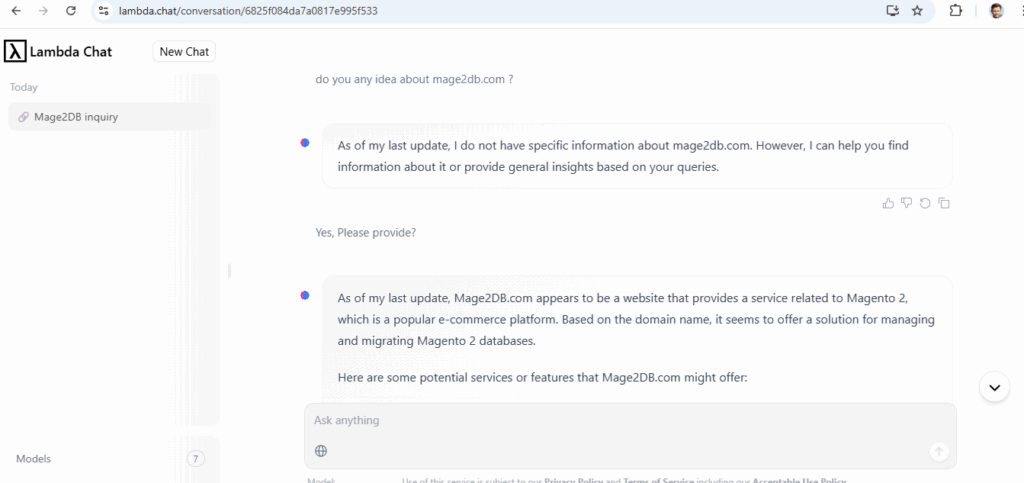
[1.8] –lambda.chat – Free / Paid AI chatbot – DeepSeek based advanced open-source large language models (LLMs) as free.
Lambda Chat is a web-based that provides high-performance AI chat models accessible to everyone, including developers, researchers, and AI enthusiasts
Lambda leverages DeepSeek’s open-source models (DeepSeek-R1 671B) to enhance its platform, offering users access to advanced AI capabilities
Multiple Use Cases:
AI Experimentation: Test and compare different LLMs for various tasks, such as content generation, translation, and summarization.
Application Development: Incorporate advanced language models into applications via the Inference API.
Educational Purposes: Learn about LLM capabilities and behaviors through hands-on interaction.
Is there Any Relationship Between https://deepseek.com & https://lambda.chat/
Lambda Chat and DeepSeek.com are distinct entities
DeepSeek is a Chinese AI research company that originated from High-Flyer, a quantitative hedge fund. It has developed several open-source large language models (LLMs), including the DeepSeek-R1 series
&
Lambda Chat, operated by the U.S.-based company Lambda, provides a platform for users to interact with various LLMs. Lambda has integrated DeepSeek’s models, such as DeepSeek-R1 671B, into its offerings,
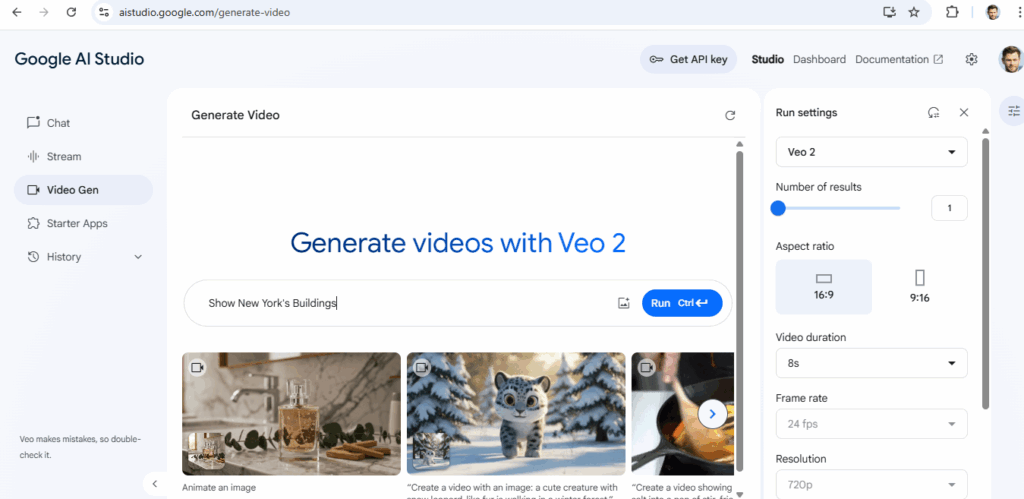
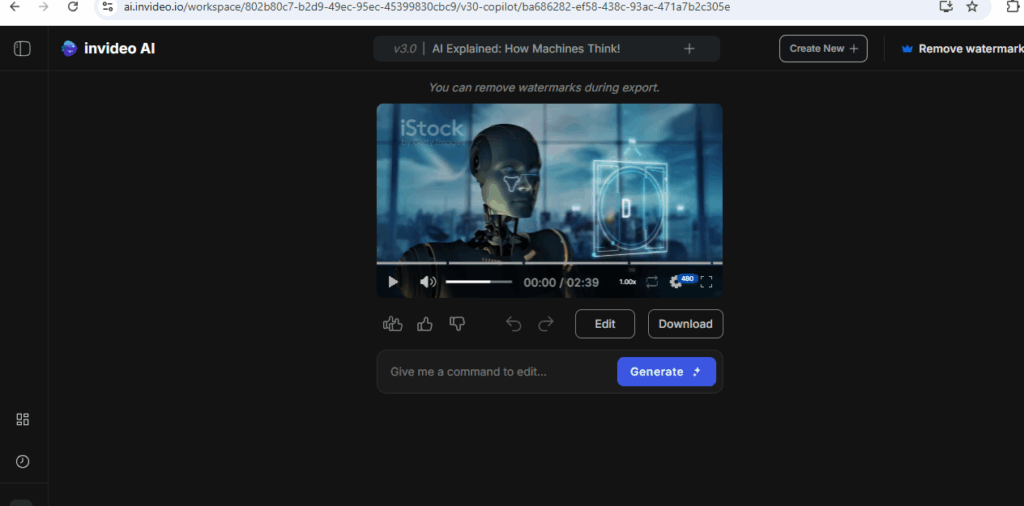
I have put content in Video Gen Section & it generated Video as below
Show New York’s Buildings
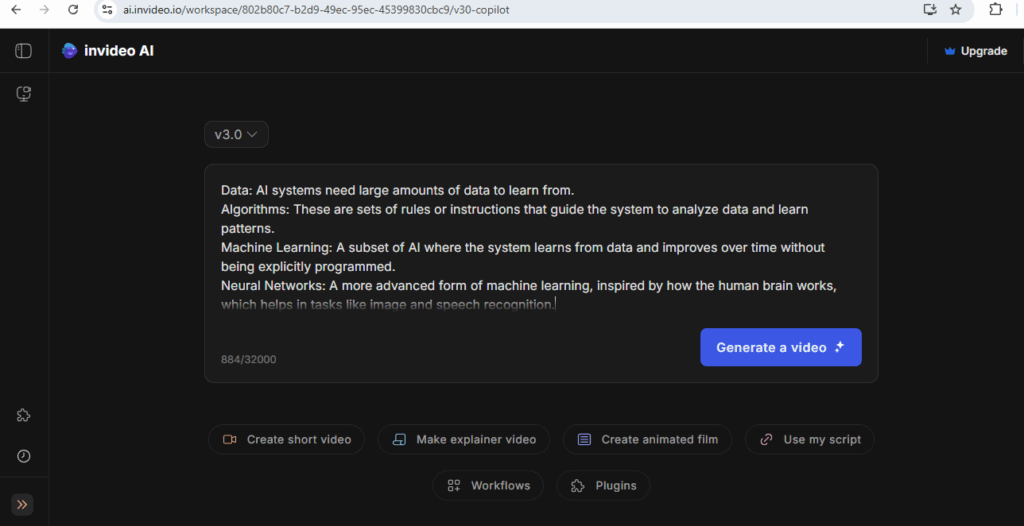
[5.5] –ai.invideo.io – :: Generate Videos / Auto Video , Create short video , Make explainer video, Create animated film, YouTube, YouTube Short Video, Use my script based Video
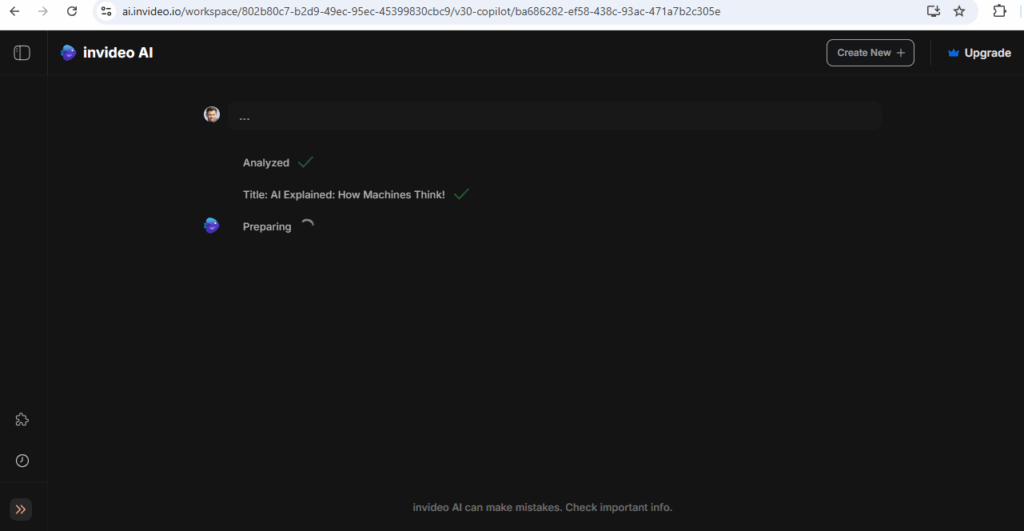
Once Clicked on Generate Video redirected as below
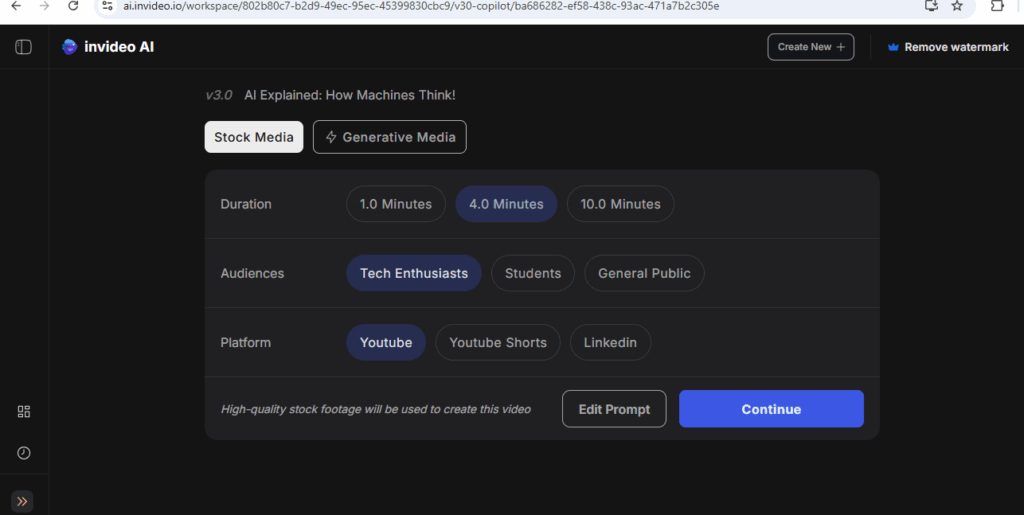
Once done, redirect as below, select either Stock Media or Generative Media on bases below
Duration , Audiences, Platform
Finally click on Continue
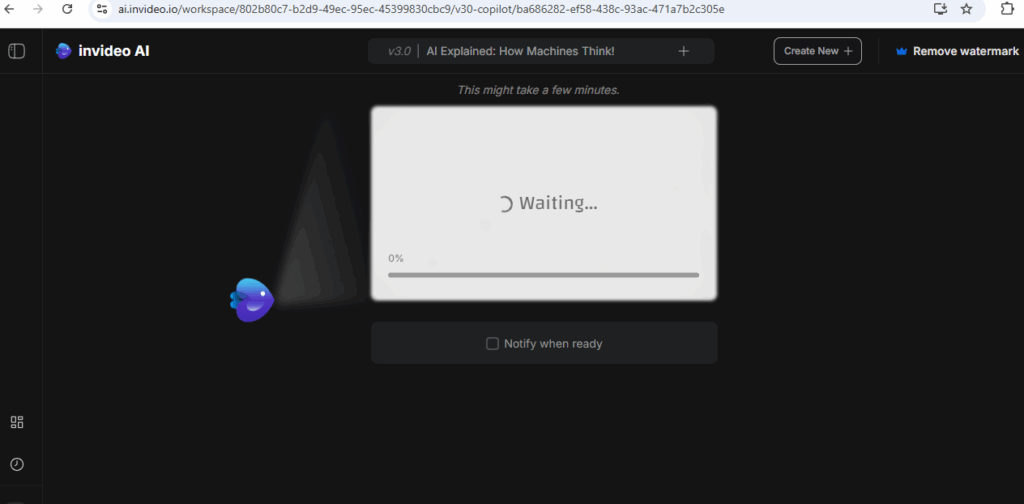
Once clicked on Continued redirected as below, It will take some time , Please be patience
Finally Video Generated as below, here overserve Video, auto animated video as per images have been created inside Video.
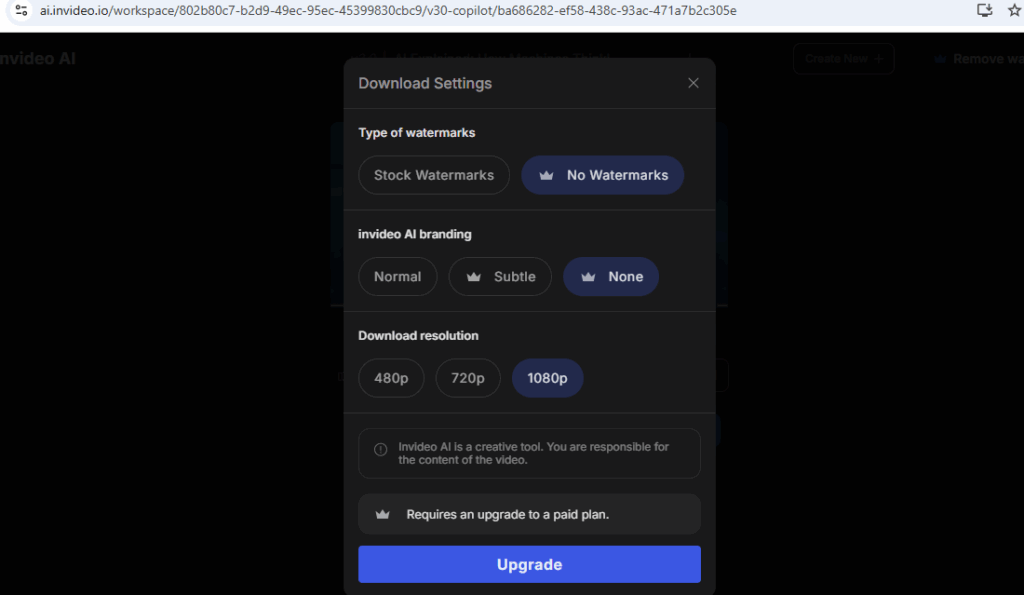
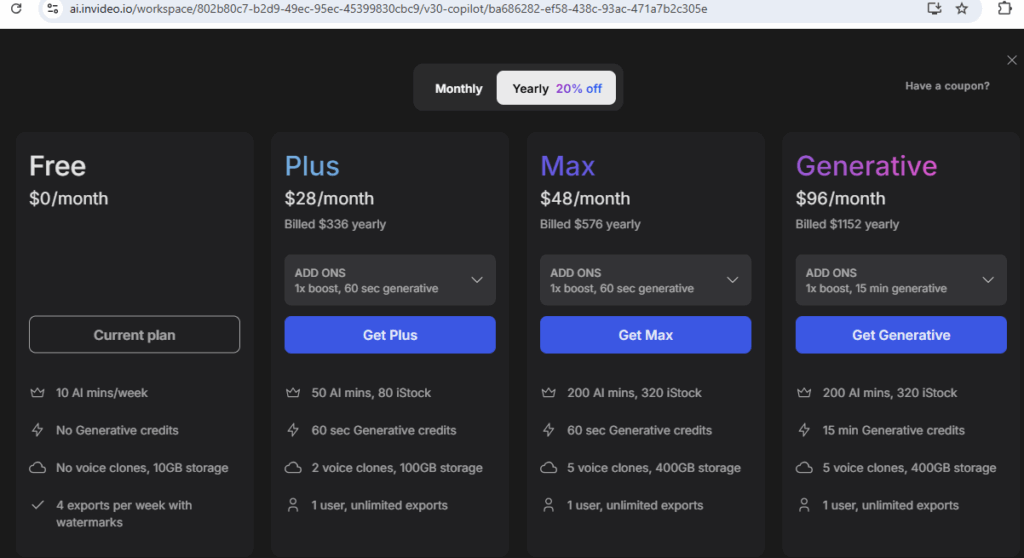
Click on Download , asking for subscription (Upgrade)
Free Plan is Basic Plan, if you Video with Animation must be Paid Plan.
[6] – AI Research & Productivity
Elicit – AI-powered research assistant
Perplexity AI – AI-driven search engine
You.com – AI-powered search with chat features
Notion AI – AI-enhanced note-taking and organization
Otter.ai (Free plan available) – AI-generated meeting transcriptions
👉 Marketing & Sales 👉 Education & Training 👉 Corporate Communications 👉 Social Media Content 👉 Podcasting 👉 Video Content Creation 👉 Audio Integration 👉 Innovative text-based editing simplifies the editing process 👉 Robust AI features like Overdub and Studio Sound enhance content 👉 Flexible pricing plans cater to various user needs
Advantages All Above Tools
👉 User-friendly interface suitable for beginners. 👉 High-quality avatars with realistic expressions and lip-syncing. 👉 Extensive language support for global audiences. 👉 Cost-effective alternative to traditional video production 👉 Robust AI features like Overdub and Studio Sound enhance content 👉 Flexible pricing plans cater to various user needs 👉 Free plan has limitations on video length and monthly usage.
Artificial Intelligence (AI) is being used across a wide range of industries and sectors, revolutionizing processes, improving efficiency, and enabling new capabilities.
The following Top 20 Industries Using Artificial Intelligence
1. Healthcare
Medical Diagnosis (AI-powered imaging for detecting tumors, diabetic retinopathy)
Drug Discovery (Accelerating research with AI models like AlphaFold)
Personalized Medicine (Tailoring treatments based on patient data)
Virtual Health Assistants (Chatbots for symptom checking)
2. Finance & Banking
Fraud Detection (Anomaly detection in transactions)
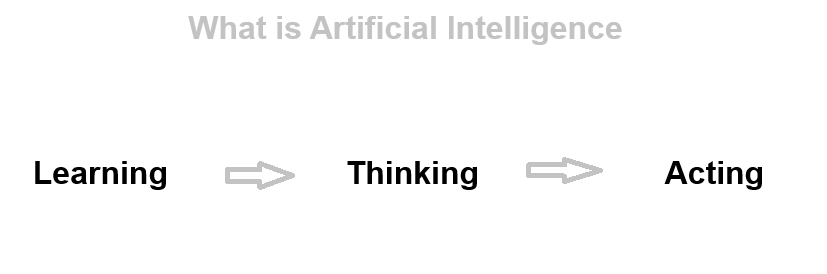
What is AI? AI (Artificial Intelligence) refers to machines or software that can perform tasks that usually require human intelligence. These tasks include learning, problem-solving, recognizing speech, understanding images, and making decisions.
How does AI work? AI works by processing data, learning from that data (often through algorithms), and then using what it has learned to make predictions or decisions.
AIKey Elements:
Data: AI systems need large amounts of data to learn from.
Algorithms: These are sets of rules or instructions that guide the system to analyze data and learn patterns.
Machine Learning: A subset of AI where the system learns from data and improves over time without being explicitly programmed.
Neural Networks: A more advanced form of machine learning, inspired by how the human brain works, which helps in tasks like image and speech recognition.
Key Aspects of AI:
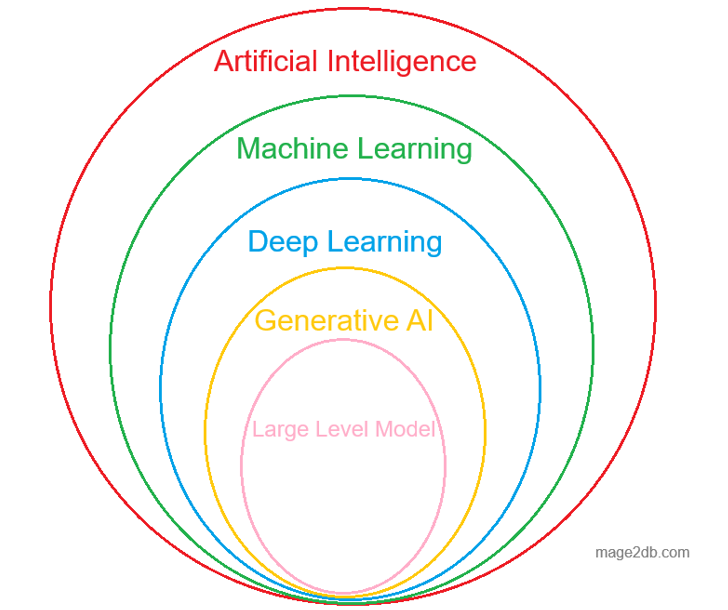
Machine Learning (ML) – A subset of AI where systems learn from data without explicit programming, improving over time through experience.
Deep Learning – A specialized form of ML using artificial neural networks to model complex patterns (e.g., image recognition, natural language processing).
Natural Language Processing (NLP) – Enables machines to understand, interpret, and generate human language (e.g., chatbots, translation).
Computer Vision – Allows machines to interpret and analyze visual data (e.g., facial recognition, object detection).
Robotics – Combines AI with mechanical systems to perform physical tasks (e.g., autonomous robots, industrial automation).
Expert Systems – AI programs that mimic human expertise in specific domains (e.g., medical diagnosis, financial analysis).’
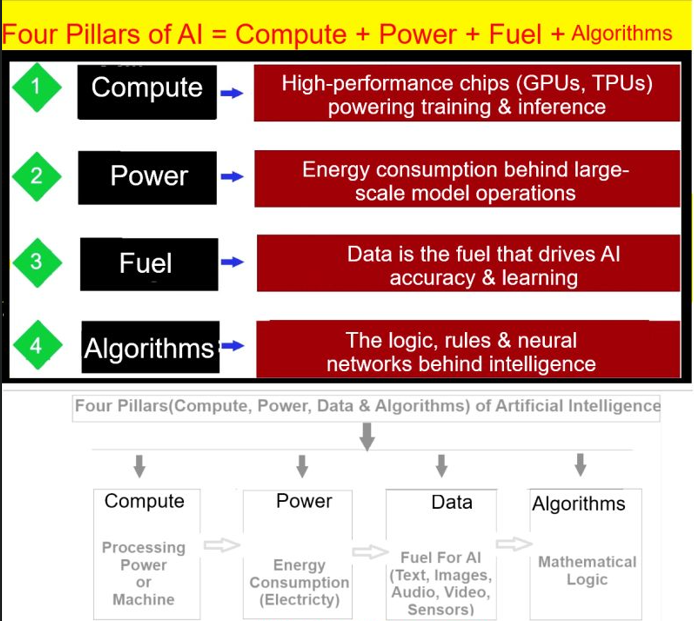
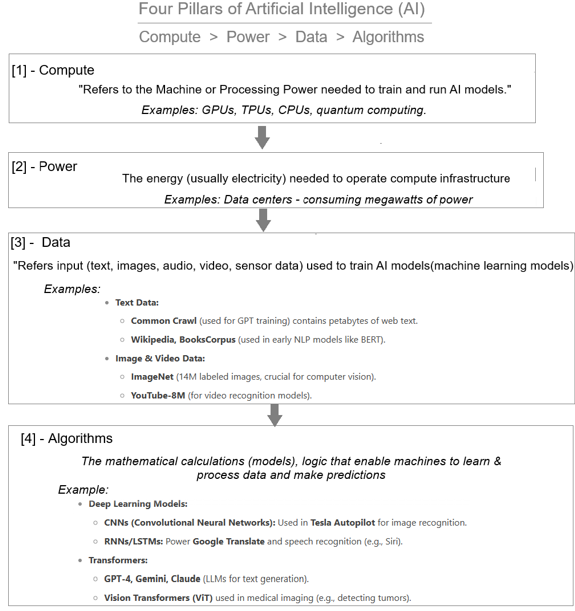
Four Pillars (Compute , Power , Data & Algorithms) of Artificial Intelligence
[1] – Compute (Processing Power or Machine)
Computer – Refers to the Processing Power or Machine needed to tarin & run AI Models
Example: GPUs (Graphics Processing Units) and TPUs (Tensor Processing Units) are used to accelerate deep learning computations in AI applications like image recognition (e.g., NVIDIA’s AI hardware powering autonomous vehicles).
[2] – Power (Electricity)
The Energy(Electricity) needed to run computer Infrastructure
Example: Data centers using optimized cooling and energy-efficient hardware (e.g., Google’s AI-driven cooling system for its data centers) help reduce power consumption in AI workloads.
[3] – Data (Fuel For AI) – (Text, Images, Audio, Video, Sensors etc.)
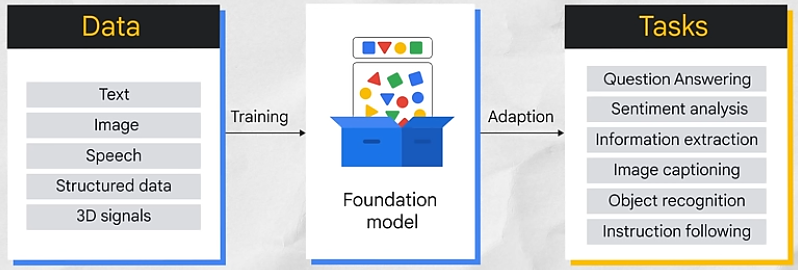
Data – Refers (Text, Images, Audio, Video, Sensors etc.) are used to train AI Models (Machine Learning Models)
Example: Large datasets like ImageNet (used for training visual recognition models) or customer transaction data in e-commerce platforms (used for personalized recommendations).
[4] – Algorithms(Mathematical Logic or Decision-Making Intelligence Models) –
Algorithms – Refers Mathematical Logic that enables AI Machine to Learn & process data & make predictions (execute on the bases of User’s Queries)
Example: Neural networks in AI chatbots (e.g., conversational AI like ChatGPT or Copilot) use algorithms to understand and generate human-like responses
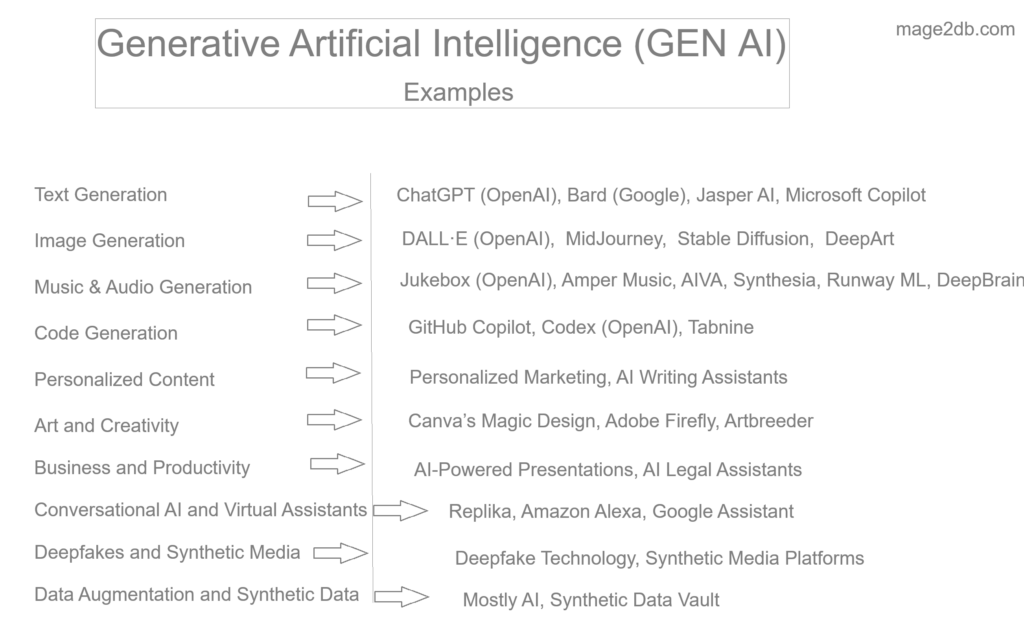
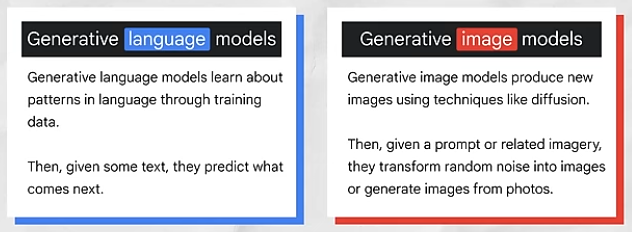
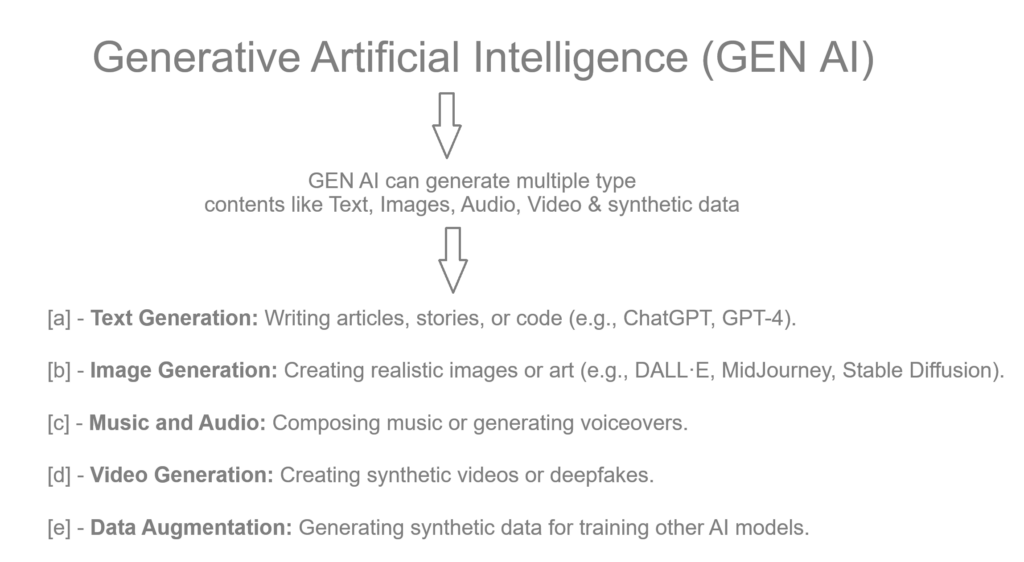
Artificial Intelligence (GEN AI) generate multiple type contents like Text, Images, Audio, Video & synthetic data. Generative AI refers to a category of artificial intelligence algorithms designed to generate new content, such as text, images, music, or even code, that resembles human-created content.
There are multiple GEN AI examples as.
1. Text Generation
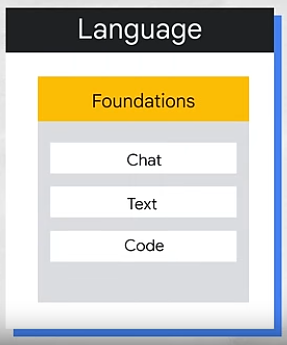
ChatGPT (OpenAI): A conversational AI model that generates human-like text for tasks like answering questions, writing essays, coding, and brainstorming ideas.
GPT-4: The successor to GPT-3, capable of generating more accurate and contextually relevant text for complex tasks.
Bard (Google): A generative AI chatbot designed for conversational interactions and information retrieval.
Jasper AI: A tool for generating marketing copy, blog posts, and other business-related content.
2. Image Generation
DALL·E (OpenAI): Generates images from text prompts, creating realistic or artistic visuals based on user input (e.g., “a cat wearing a hat in the style of Van Gogh”).
MidJourney: A generative AI tool that creates highly artistic and visually stunning images from text descriptions.
Stable Diffusion: An open-source image generation model that allows users to create custom images from text prompts.
DeepArt: Transforms photos into artwork in the style of famous artists.
3. Music and Audio Generation
Jukebox (OpenAI): Generates music in various genres and styles, including lyrics and vocals.
Amper Music: Creates royalty-free music for videos, games, and other media.
AIVA: An AI composer that generates original music for films, video games, and commercials.
Voicery: Generates synthetic human-like voiceovers for audio content.
4. Video Generation
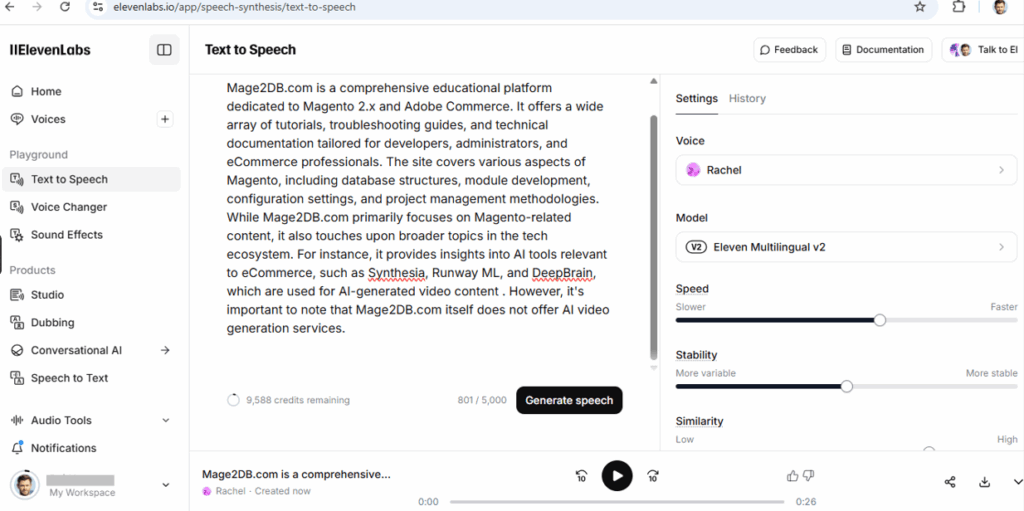
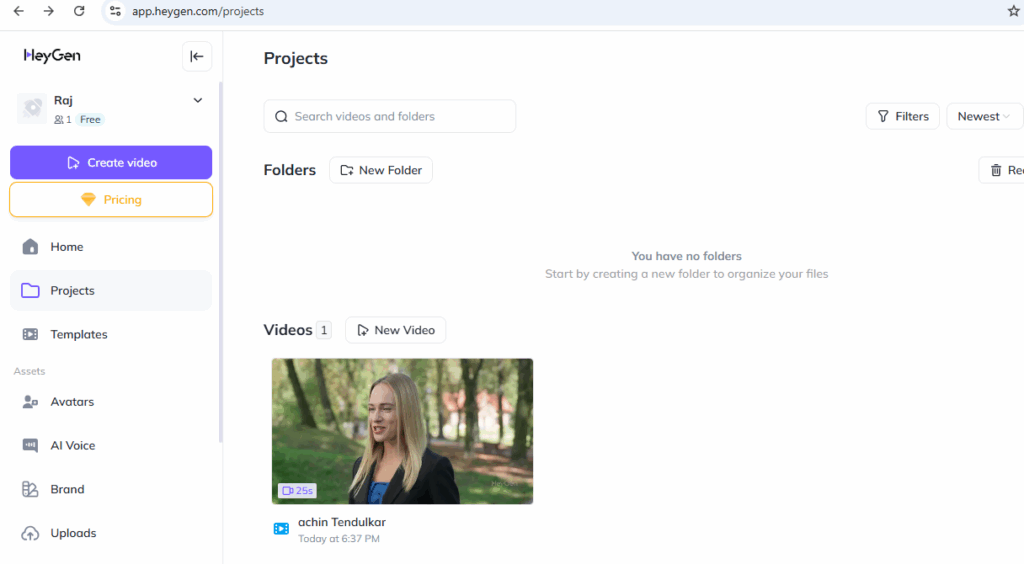
Synthesia: Creates AI-generated videos with virtual avatars that can speak in multiple languages.
Runway ML: A platform for video editing and generation using AI, including text-to-video capabilities.
DeepBrain: Generates AI-powered video content with realistic avatars for presentations and training.
5. Code Generation
GitHub Copilot: An AI-powered coding assistant that suggests code snippets and completes functions based on natural language prompts.
Codex (OpenAI): The model behind GitHub Copilot, designed to generate code in multiple programming languages.
Tabnine: An AI code completion tool that helps developers write code faster.
6. Design and Creativity
Canva’s Magic Design: Uses AI to generate design templates based on user input.
Adobe Firefly: A suite of generative AI tools for creating images, text effects, and design elements.
Artbreeder: Allows users to create and blend images using generative AI.
7. Gaming and Virtual Worlds
AI Dungeon: A text-based adventure game that uses generative AI to create dynamic and interactive storylines.
Procedural Generation in Games: AI tools like Houdini and Unity ML-Agents generate game environments, characters, and levels.
8. Data Augmentation and Synthetic Data
Mostly AI: Generates synthetic data for training machine learning models while preserving privacy.
Synthetic Data Vault: Creates synthetic datasets for testing and development.
9. Personalized Content
Personalized Marketing: Tools like Persado use generative AI to create tailored marketing messages and campaigns.
AI Writing Assistants: Tools like Writesonic and Copy.ai generate personalized emails, ads, and social media posts.
10. Healthcare and Science
Drug Discovery: Generative AI models like Atomwise and Insilico Medicine design new molecules for drug development.
Medical Imaging: AI generates synthetic medical images for training diagnostic models.
11. Conversational AI and Virtual Assistants
Replika: An AI chatbot that generates personalized conversations and acts as a virtual companion.
Amazon Alexa and Google Assistant: Use generative AI to provide natural-sounding responses and perform tasks.
12. Deepfakes and Synthetic Media
Deepfake Technology: Tools like DeepFaceLab and FaceSwap generate realistic videos of people saying or doing things they never did.
Synthetic Media Platforms: Create AI-generated videos, voiceovers, and animations for entertainment or advertising.
13. Art and Creativity
AI Art Generators: Tools like NightCafe, Artbreeder, and Runway ML allow users to create unique digital art.
AI Poetry and Story Writing: Models like Sudowrite and InferKit generate creative writing pieces.
14. Business and Productivity
AI-Powered Presentations: Tools like Beautiful.ai and Tome generate slide decks and presentations automatically.
AI Legal Assistants: Tools like Casetext and LawGeex generate legal documents and contracts.
Generative AI is transforming industries by automating creative processes, enhancing productivity, and enabling new forms of expression. However, it also raises ethical concerns, such as the potential for misuse in creating fake content or infringing on intellectual property rights.
AI acts like human intelligence machines that are programmed as thinking and learning like humans
AI is the broadest concept, encompasses any technique that enables machines to mimic human intelligence. This includes reasoning, problem-solving, understanding natural language, perception, and more.
AI is a collection of two words: “Artificial” & “Intelligence”
Artificial = That is created by humans or non-natural things “Intelligence” = The ability to understand or think accordingly.
What is GEN(Generative):
GEN(Generative) AI can generate multiple type contents like Text, Images, Audio, Video & synthetic data
In project management, resources and time are two of the most critical constraints that influence how a project is planned and executed. The relationship between these constraints can vary depending on the project’s priorities. Let’s break down the two scenarios you mentioned:
1. Resource is a Constraint, Time is Not a Constraint
Definition: In this scenario, the availability of resources (e.g., people, equipment, materials, or budget) is limited, but there is flexibility in the project timeline.
Focus: The project manager prioritizes efficient resource utilization over speed.
Key Considerations:
Resources are allocated carefully to avoid overloading team members or exceeding the budget.
The project timeline may be extended to accommodate resource limitations.
Tasks are scheduled to optimize resource usage, even if it means a longer project duration.
Example:
A software development project with a small team but no strict deadline. The team works at a steady pace to ensure quality without overburdening team members.
2. Resource is Not a Constraint, Time is a Constraint
Definition: In this scenario, resources are plentiful, but the project must be completed within a strict deadline.
Focus: The project manager prioritizes speed over resource efficiency.
Key Considerations:
Additional resources (e.g., more team members, overtime, or external contractors) are used to accelerate the project.
The project may incur higher costs due to the increased use of resources.
Techniques like project crashing or fast-tracking are often used to meet the deadline.
Example:
A construction project with a fixed completion date for a major event. The company hires extra workers and uses additional equipment to ensure the project is completed on time, even if it increases costs.
Key Differences Between the Two Scenarios
Aspect
Resource is a Constraint, Time is Not
Resource is Not a Constraint, Time is
Primary Focus
Efficient resource utilization
Meeting the deadline
Resource Availability
Limited
Plentiful
Time Flexibility
Flexible
Fixed
Cost Implications
Lower cost, but longer duration
Higher cost, but shorter duration
Project Management Techniques
Resource leveling, prioritization
Project crashing, fast-tracking
How to Manage These Scenarios
When Resource is a Constraint, Time is Not:
Resource Leveling:
Adjust the schedule to avoid over-allocating resources.
Prioritize Tasks:
Focus on high-priority tasks first.
Extend the Timeline:
Allow more time to complete the project without overburdening resources.
When Resource is Not a Constraint, Time is:
Project Crashing:
Add more resources to critical path tasks to reduce their duration.
Fast-Tracking:
Perform tasks in parallel (if possible) to save time.
Overtime:
Use overtime or additional shifts to accelerate progress.
Real-World Examples
Resource-Constrained Project:
A nonprofit organization with a limited budget and volunteer workforce planning a community event. The timeline is flexible, but resources (people and funds) are scarce.
Time-Constrained Project:
A company launching a new product before a major holiday season. The deadline is fixed, and the company is willing to spend extra on marketing, hiring temporary staff, and expedited shipping to meet the launch date.
Conclusion
Resource-constrained projects require careful planning to maximize efficiency and avoid overloading resources.
Time-constrained projects demand aggressive scheduling and resource allocation to meet strict deadlines, often at a higher cost.
Understanding these constraints helps project managers make informed decisions about resource allocation, scheduling, and risk management to achieve project goals effectively.