
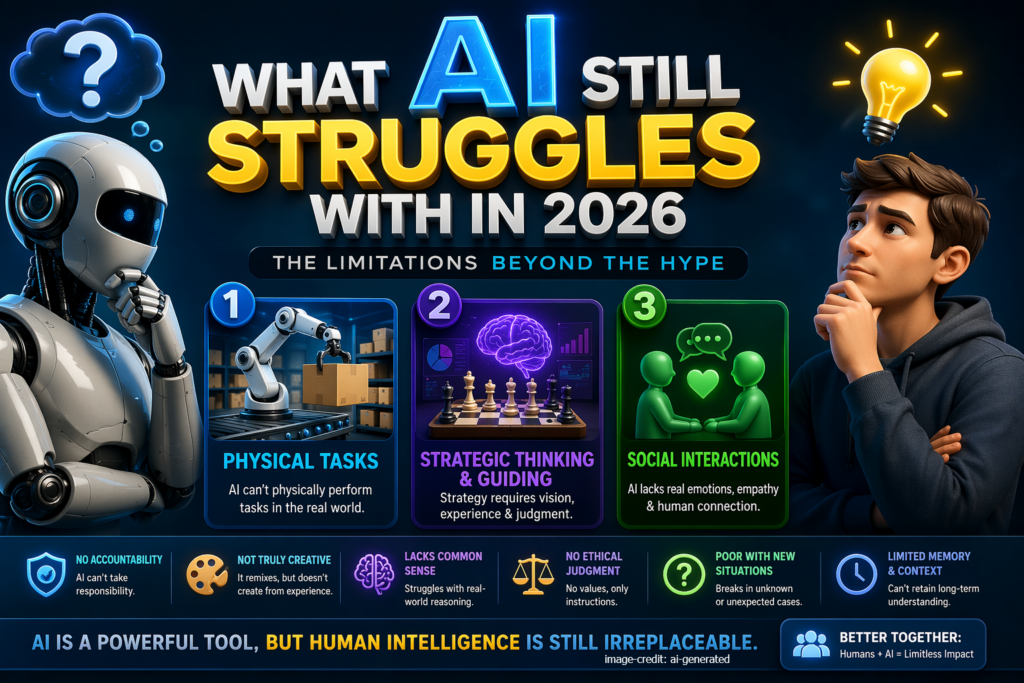
Artificial Intelligence has made massive progress—writing code, generating videos, automating workflows, and even simulating conversations. But despite all the hype, there are still critical areas where AI is limited, unreliable, or simply not capable.
If you’re building products, hiring teams, or planning strategy, understanding these gaps gives you a real competitive advantage.
Let’s break down the three major limitations you mentioned, and expand into more areas where AI still falls short.
🧠 1. Physical Tasks (Real-World Execution)
AI can control machines, but it cannot physically exist or operate in the real world without hardware—and even then, it’s far from perfect.
❌ Where AI struggles:
- Performing manual labor (construction, plumbing, repairs)
- Handling unpredictable environments
- Fine motor skills (delicate assembly, surgery-level precision without supervision)
- Real-time adaptation in physical chaos (crowds, weather, accidents)
💡 Why?
AI lacks:
- True sensory understanding (touch, balance, spatial awareness)
- Real-world experience
- Reliable robotics integration at scale
👉 Even advanced robotics still struggles with tasks a human can do instinctively.
🎯 2. Strategic Thinking & True Decision-Making
AI can analyze data—but strategy is not just data.
❌ Where AI struggles:
- Long-term vision planning
- Business strategy under uncertainty
- Trade-offs involving ethics, risk, and human impact
- Making decisions with incomplete or ambiguous data
💡 Why?
AI:
- Relies on past data (not future intuition)
- Cannot own responsibility
- Doesn’t understand consequences in a human sense
👉 It can assist strategy, but cannot lead it.
🤝 3. Social Interaction & Human Relationships
AI can simulate conversation—but it doesn’t feel anything.
❌ Where AI struggles:
- Building trust over time
- Reading emotional nuance deeply
- Handling sensitive human situations (conflict, grief, negotiation)
- Cultural context and social intelligence
💡 Why?
AI lacks:
- Emotional experience
- Empathy rooted in lived reality
- Genuine intent
👉 It’s a tool for communication—not a replacement for human connection.
⚠️ MORE AREAS WHERE AI IS STILL LIMITED
Here are additional critical limitations most people overlook:
🧭 4. Accountability & Responsibility
AI can suggest—but it cannot be held accountable.
- No legal responsibility
- No moral ownership
- No consequences for mistakes
👉 Humans must always be in the loop.
🎨 5. True Creativity & Original Thought
AI generates based on patterns—not pure originality.
- Remixing existing ideas
- Lacks lived experience
- Cannot create from emotion or purpose
👉 It accelerates creativity, but doesn’t originate it.
🧩 6. Common Sense Reasoning
AI still fails at simple real-world logic sometimes.
- Misinterprets context
- Gives technically correct but practically wrong answers
- Struggles with ambiguity
🧑⚖️ 7. Ethical Judgment
AI doesn’t have values—it follows instructions.
- Bias issues
- No moral compass
- Cannot resolve ethical dilemmas independently
🗺️ 8. Handling Completely New Situations
AI performs poorly in unknown, never-seen-before scenarios.
- Relies heavily on training data
- Breaks in edge cases
- Cannot “improvise” like humans
🧬 9. Deep Domain Expertise (Without Oversight)
AI can assist experts—but cannot replace them.
- Doctors, lawyers, engineers still required
- Risk of hallucinations
- Needs validation
🧠 10. Long-Term Memory & Context Continuity
AI struggles with:
- Persistent understanding over time
- Deep personal or organizational memory
- Context across long workflows
🛠️ 11. Execution Ownership
AI can suggest tasks—but:
- Cannot ensure completion
- Cannot manage teams
- Cannot take initiative independently (without systems)
🚀 FINAL TAKEAWAY
AI is extremely powerful—but it is not a replacement for humans.
👉 Think of AI as:
- A co-pilot, not a pilot
- An assistant, not a decision-maker
- A tool, not a leader
🔥 THE REAL OPPORTUNITY
Instead of asking:
❌ “What can AI replace?”
Start asking:
✅ “Where do humans + AI together create maximum impact?”