The latest release of Adobe’s Adobe Commerce introduces one of the biggest modernization upgrades in recent years.
Adobe Commerce 2.4.9 – has been released on 12 May 2026
Adobe Commerce 2.4.9 focuses heavily on:
- Enterprise scalability
- Cloud-native readiness
- Headless commerce
- Modern infrastructure
- Security hardening
- Faster performance
- Future-ready technology stack
For enterprise retailers, B2B organizations, and high-traffic eCommerce businesses, this release provides major improvements across infrastructure, APIs, caching, search, checkout, and developer experience.
🚀 Why Adobe Commerce 2.4.9 Matters
Modern eCommerce platforms must support:
- Millions of products
- High concurrent traffic
- Omnichannel commerce
- AI-driven personalization
- Secure APIs
- Faster deployments
- Headless storefronts
- Cloud-native scalability
Adobe Commerce 2.4.9 addresses these enterprise requirements through massive backend modernization and infrastructure upgrades.
🔥 Key Features & Technology Upgrades
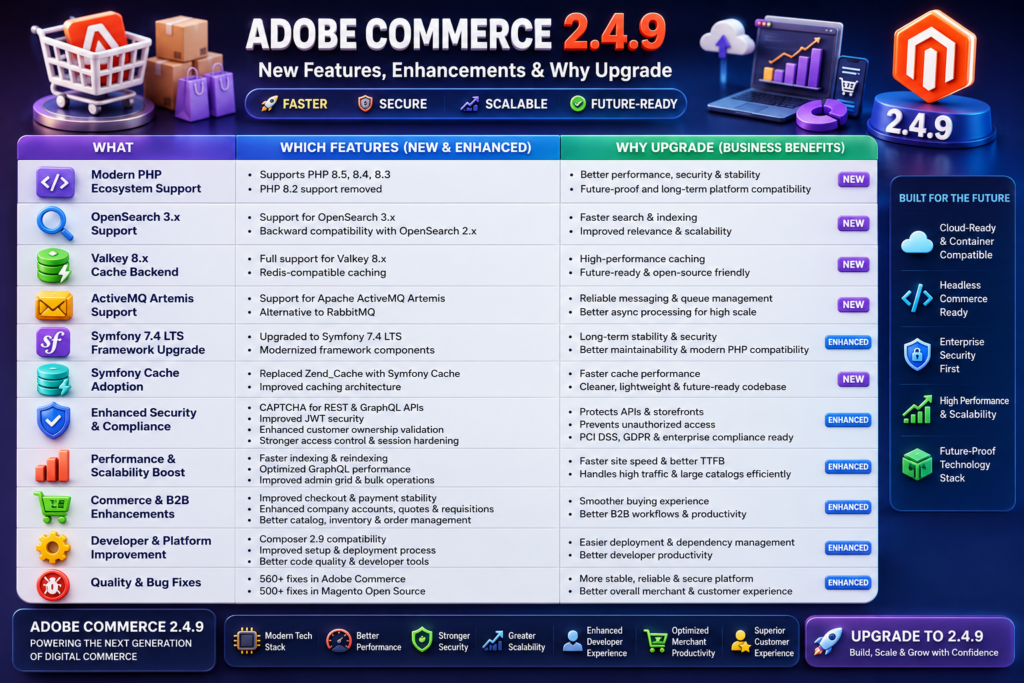
| WHAT | WHICH FEATURES (NEW & ENHANCED) | WHY UPGRADED |
|---|---|---|
| PHP Ecosystem | Support for PHP 8.5, 8.4 & 8.3 | Faster performance, better security & future compatibility |
| OpenSearch 3.x | Modern search engine support | Faster search, indexing & scalability |
| Valkey 8.x | Redis-compatible cache backend | Future-ready high-performance caching |
| ActiveMQ Artemis | Enterprise queue management | Better async processing & cloud scalability |
| Symfony 7.4 LTS | Modern framework upgrade | Long-term stability & maintainability |
| Symfony Cache | Replaced legacy Zend_Cache | Faster cache architecture |
| API Security | JWT, CAPTCHA & GraphQL security enhancements | Stronger API protection |
| Checkout Enhancements | Improved payment & checkout stability | Better customer conversion |
| B2B Improvements | Enhanced company accounts, quotes & requisitions | Better procurement workflows |
| Admin Performance | Faster indexing & bulk operations | Improved merchant productivity |
| Cloud Readiness | Kubernetes & container improvements | Better enterprise scaling |
| Composer 2.9 | Modern dependency management | Easier deployments |
| Quality Fixes | 500+ fixes & stability improvements | More stable commerce platform |
⚡ Major Infrastructure Enhancements
1. PHP 8.5 & Modern Runtime Support
Adobe Commerce 2.4.9 now supports modern PHP versions.
Benefits
- Faster execution
- Improved memory optimization
- Better security
- Modern coding standards
- Future-proof architecture
This upgrade helps enterprise stores handle high traffic and large-scale operations more efficiently.
🔎 OpenSearch 3.x Support
Search performance is critical in modern commerce.
Adobe Commerce now supports:
- OpenSearch 3.x
- Backward compatibility with OpenSearch 2.x
Business Benefits
- Faster product search
- Better layered navigation
- Improved indexing
- Better customer experience
⚡ Valkey 8.x Support
Adobe Commerce now supports Valkey as a Redis-compatible caching system.
Why Important
Valkey provides:
- High-speed caching
- Better open-source governance
- Future Redis alternative
- Better infrastructure flexibility
Used For
- Full page cache
- Session management
- Queue cache
- Backend performance
☁️ ActiveMQ Artemis Support
Adobe Commerce introduces support for Apache ActiveMQ Artemis.
Benefits
- Better message queue reliability
- Improved async processing
- Enterprise-grade messaging
- Better cloud-native scaling
Important For
- Order processing
- Inventory synchronization
- API integrations
- Event-driven commerce architecture
🛡️ Enhanced Security & Compliance
Security continues to be a major focus.
New Enhancements
- Improved JWT security
- CAPTCHA for APIs
- Better customer ownership validation
- Stronger access controls
- Session hardening
Enterprise Advantages
- PCI DSS readiness
- Better API protection
- Reduced security vulnerabilities
- Stronger compliance posture
🚀 Headless Commerce Improvements
Adobe Commerce continues investing heavily in headless commerce architecture.
Improved Areas
- GraphQL APIs
- API authentication
- PWA compatibility
- Frontend decoupling
Supported Frontend Technologies
- React
- Next.js
- Vue.js
- PWA Studio
This makes Adobe Commerce ideal for modern omnichannel commerce experiences.
🏢 B2B Commerce Enhancements
Adobe Commerce 2.4.9 improves enterprise B2B workflows.
Enhanced Features
- Shared catalogs
- Company accounts
- Purchase orders
- Requisition lists
- Quote workflows
Benefits
- Better procurement management
- Faster B2B ordering
- Improved account hierarchy management
⚙️ Admin & Merchant Productivity Improvements
Adobe Commerce 2.4.9 improves backend operational efficiency.
Improvements
- Faster admin grids
- Better indexing performance
- Improved product save operations
- Better bulk actions
Business Impact
- Faster catalog management
- Reduced admin delays
- Better operational productivity
📈 Performance & Scalability Improvements
Performance optimization remains a key focus.
Enhanced Areas
- Faster indexing
- Better cache invalidation
- Optimized GraphQL performance
- Reduced database overhead
- Improved cron operations
Results
- Faster storefronts
- Better TTFB
- Improved high-traffic stability
- Better scalability
☁️ Cloud-Native & Enterprise Ready
Adobe Commerce 2.4.9 is built for modern cloud infrastructure.
Cloud Improvements
- Better Kubernetes support
- Containerized deployment optimization
- Horizontal scalability
- Better async operations
Ideal For
- Enterprise retail
- Global marketplaces
- Omnichannel commerce
- High-volume B2B stores
🔥 Why Businesses Should Upgrade to Adobe Commerce 2.4.9
Key Advantages
✅ Faster Performance
Improved infrastructure and caching deliver faster storefront speed.
✅ Stronger Security
Modern security enhancements improve enterprise protection.
✅ Better Scalability
Optimized for high-traffic enterprise commerce.
✅ Future-Proof Technology Stack
Support for latest PHP, OpenSearch, Valkey, and Symfony ecosystem.
✅ Better Developer Experience
Modern tooling improves deployment and maintenance workflows.
✅ Improved Customer Experience
Faster checkout, search, and storefront interactions.
🎯 Best Use Cases for Adobe Commerce 2.4.9
Adobe Commerce 2.4.9 is ideal for:
- Enterprise eCommerce
- B2B Commerce
- Marketplace Platforms
- Omnichannel Retail
- Headless Commerce
- High-Traffic Commerce
- Global Commerce Deployments
📌 Final Thoughts
Adobe Commerce is more than just a regular upgrade — it represents a major modernization step toward:
- Cloud-native commerce
- Headless architecture
- Enterprise scalability
- Modern infrastructure
- Future-ready eCommerce platforms
For businesses planning long-term digital commerce growth, Adobe Commerce 2.4.9 delivers a strong foundation for scalable, secure, and high-performance enterprise commerce.