
Artificial Intelligence is transforming industries such as healthcare, finance, manufacturing…
Table of Contents
- Introduction
- What Is an AI Data Center?
- Why AI Data Centers Are Required
- AI Data Center Architecture
- Example – AI-Powered B2C Marketplace Workflow
- Major Components
- AI Data Center vs Traditional Data Center
- Applications
- Benefits
- Challenges
- Cloud vs Private AI Data Centers
- Role of Edge AI Data Centers
- Building Sustainable AI Data Centers
- AI Data Center vs Land vs Water vs Energy
- The Future of AI Data Centers
- Conclusion
Introduction
Artificial Intelligence is transforming industries such as healthcare, finance, manufacturing, robotics, e-commerce, and cybersecurity. These applications require enormous computing power, high-speed networking, and large-scale data storage — all provided by an AI Data Center.
What Is an AI Data Center?
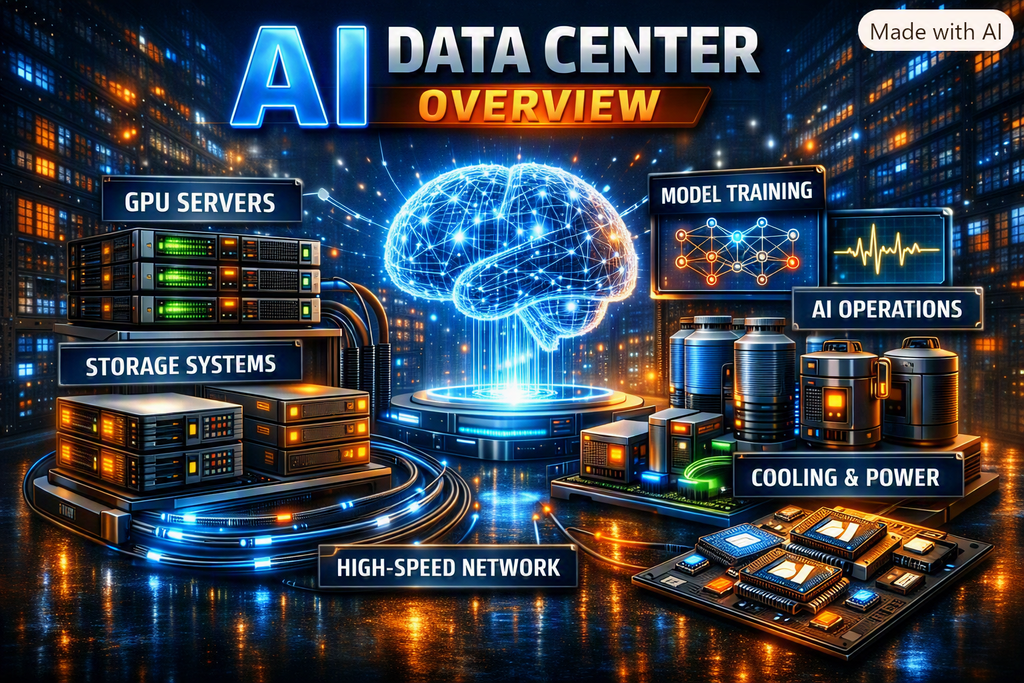
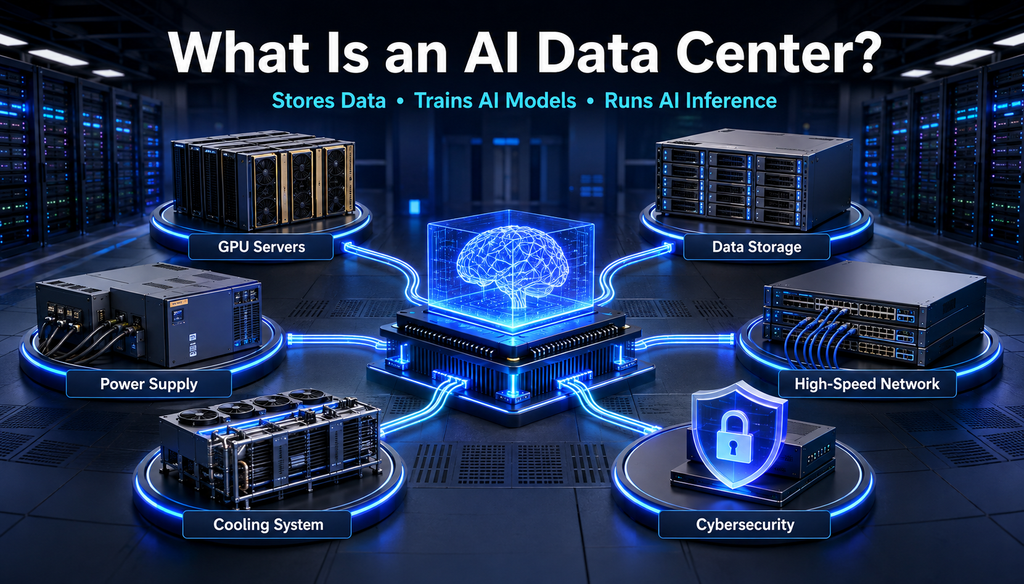
An AI data center is a specialized facility containing powerful computing infrastructure optimized for AI workloads. It includes:
- Graphics Processing Units (GPUs)
- AI accelerators and specialized chips
- High-performance servers
- High-speed networking systems
- Large-scale data storage
- Advanced cooling and power management
These centers train AI models using massive datasets and deliver real-time results to users.
Why AI Data Centers Are Required
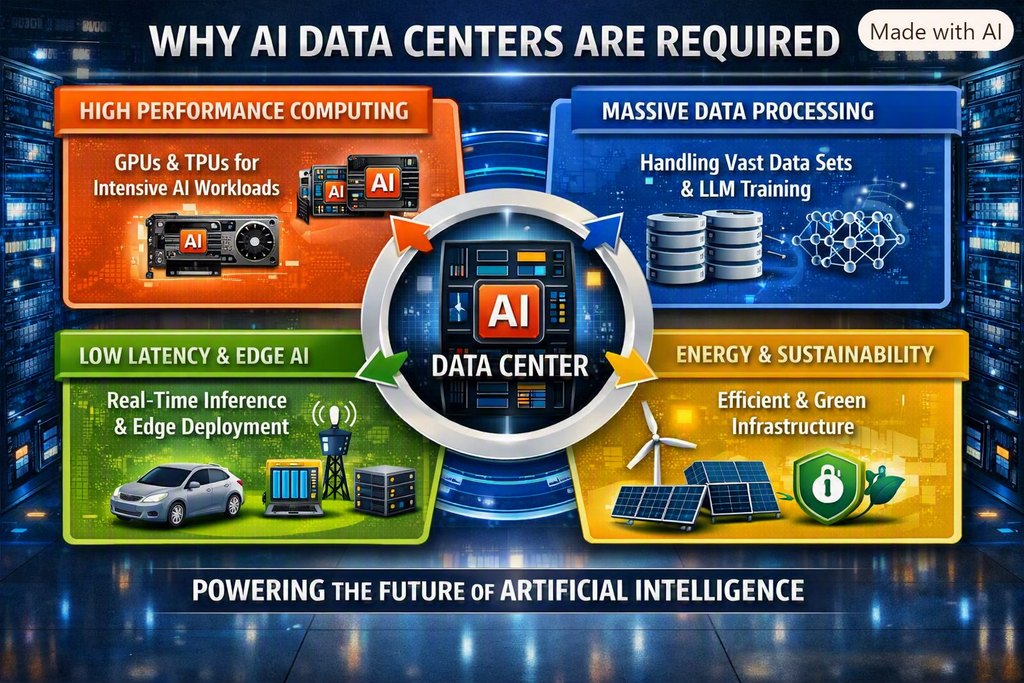
- Massive Compute Needs: Thousands of GPUs/TPUs running in parallel.
- High-Speed Networking: Ultra-low latency interconnects for petabyte-scale data transfer.
- Petabyte-Scale Storage: Specialized systems for large datasets.
- Advanced Cooling & Energy: Liquid cooling and renewable integration.
- Balanced Training & Inference: Handles both heavy training and real-time inference.
AI Data Center Architecture
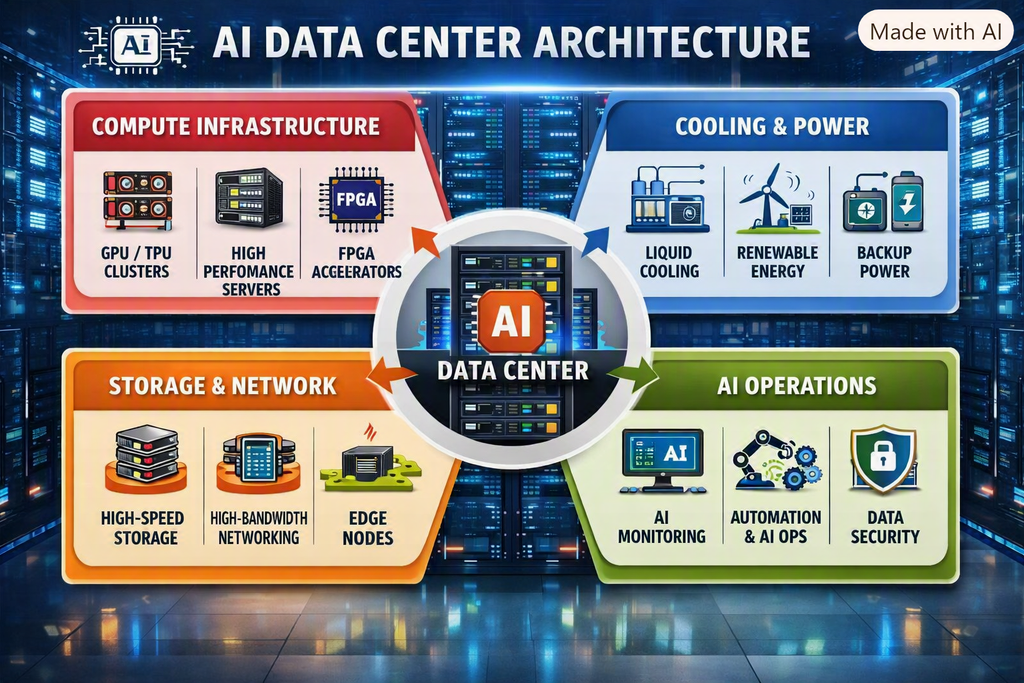
- Compute Layer: GPU/TPU clusters, FPGA/ASIC accelerators, high-density racks.
- Networking Layer: InfiniBand, NVLink, RDMA for low-latency communication.
- Storage Layer: Petabyte repositories, vector databases, NVMe SSDs.
- Cooling & Energy Layer: Liquid cooling, renewable energy, AI-driven optimization.
- AI Operations Layer (AI Ops): Auto-scaling, latency monitoring, security & compliance.
Example – AI-Powered B2C Marketplace Workflow
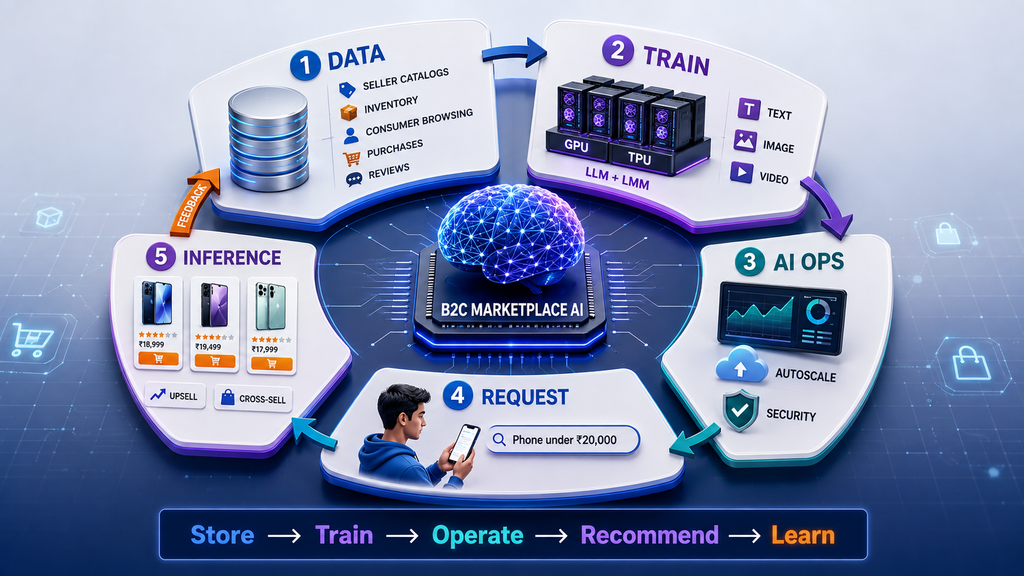
- Data Storage & Preparation: Seller, consumer, and marketplace data organized for training.
- Model Training: LLMs and LMMs trained on text, images, and videos.
- AI Operations: Monitors accuracy, scales resources, ensures compliance.
- User Request Processing: Semantic search and personalized recommendations.
- Inference & Feedback: Real-time suggestions and continuous learning.
Major Components
- GPUs and AI Accelerators: TPUs, NPUs, FPGAs, ASICs for parallel processing.
- High-Performance Servers: Thousands of interconnected GPU servers.
- Networking: High-speed Ethernet and InfiniBand.
- Storage: Scalable systems for structured and unstructured data.
- Cooling: Liquid immersion, direct-to-chip, AI-controlled systems.
- Power Infrastructure: Generators, batteries, renewable sources.
AI Data Center vs Traditional Data Center
| Area | Traditional Data Center | AI Data Center |
|---|---|---|
| Purpose | Websites, databases | AI training & inference |
| Processors | CPUs | GPUs & AI accelerators |
| Density | Moderate | Extremely high |
| Networking | Standard | High-bandwidth, low-latency |
| Cooling | Air | Liquid/advanced |
| Storage | Business data | Massive AI datasets |
| Power | Moderate | High |
Applications
- Generative AI
- Healthcare
- Autonomous Vehicles
- Robotics
- Finance
- Manufacturing
- Cybersecurity
- Scientific Research
Benefits
- Faster AI development
- Improved scalability
- Real-time performance
- Better resource utilization
- Centralized security
- Support for innovation
Challenges
- High energy consumption
- Cooling requirements
- High development cost
- Hardware availability
- Data privacy
- Cybersecurity risks
- Environmental impact
Cloud vs Private AI Data Centers
Cloud AI Data Centers: Flexible, pay-as-you-go, lower upfront cost.
Private AI Data Centers: Greater control and security, higher investment.
Hybrid Approach: Sensitive workloads on private, scalable capacity on cloud.
Role of Edge AI Data Centers
Edge AI brings computation closer to data sources for low latency — vital for autonomous vehicles, robotics, and smart cities.
Building Sustainable AI Data Centers
- Energy-efficient processors
- Renewable integration
- Liquid cooling
- Waste-heat recovery
- Server recycling
- AI-based energy monitoring
AI Data Center vs Land vs Water vs Energy
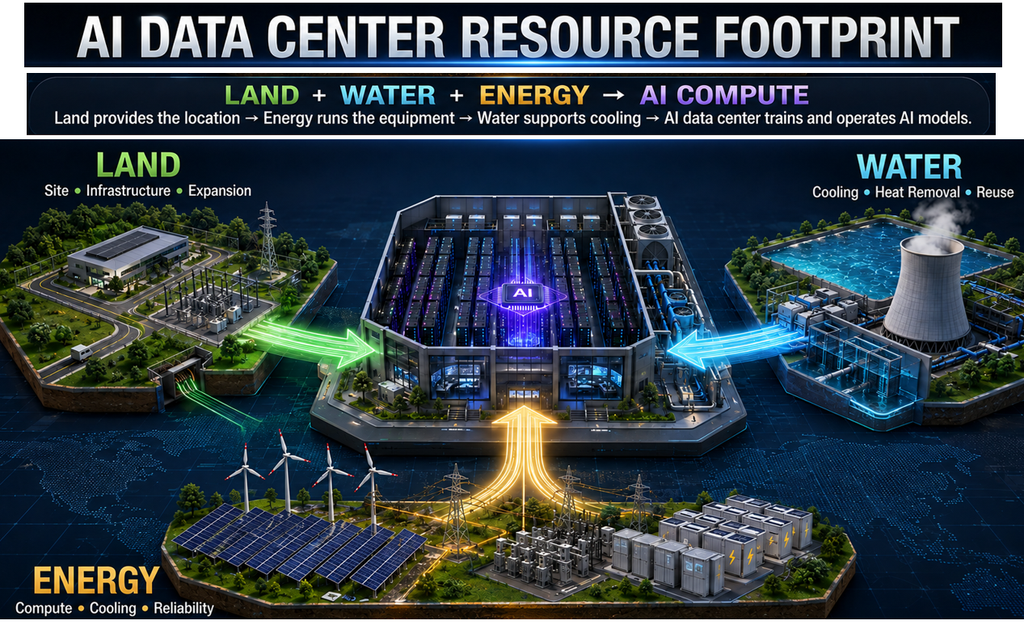
- Land: Provides space but faces scarcity and cost challenges.
- Water: Essential for cooling but raises sustainability concerns.
- Energy: Powers workloads; renewable integration reduces carbon footprint.
- AI Data Center Integration: Balances all resources for scalable intelligence.
The Future of AI Data Centers
-
Next‑Gen Hardware
Specialized processors (GPUs, TPUs, NPUs, quantum chips) and optical networking will drive faster, denser, and more efficient AI workloads.
-
Autonomous Operations
AI‑driven monitoring, predictive maintenance, and self‑healing infrastructure will make data centers more automated and resilient.
-
Distributed Ecosystem
A mix of hyperscale hubs, regional cloud facilities, and edge AI centers will balance large‑scale training with real‑time local inference.
-
Sustainability Focus
Integration of renewable energy, liquid cooling, waste‑heat recovery, and water recycling will reduce environmental impact.
-
Security & Compliance
Advanced encryption, zero‑trust frameworks, and adherence to evolving regulations (GDPR, HIPAA, AI Act) will protect sensitive AI workloads.