
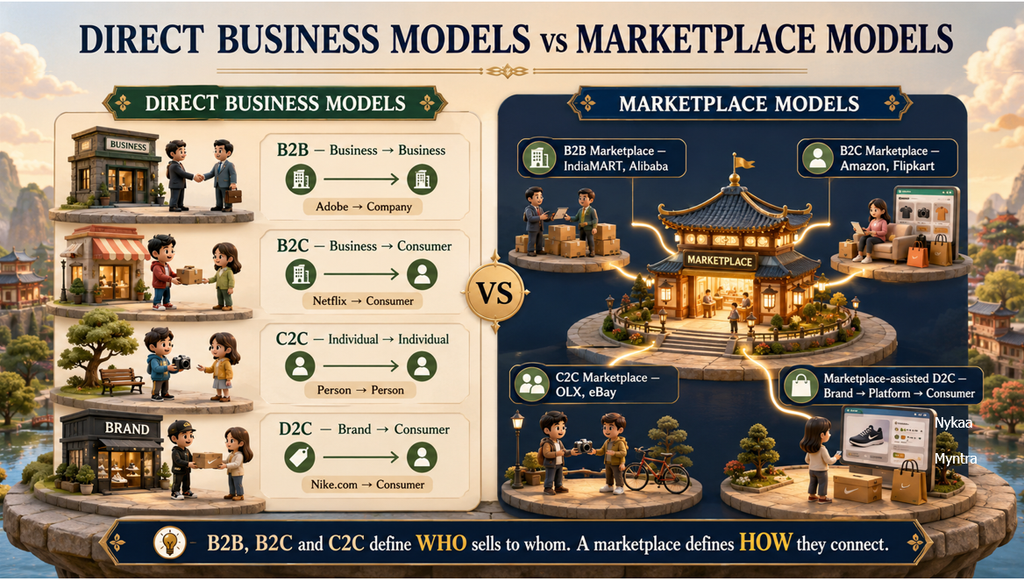
Business models such as B2B, B2C, C2C and D2C are often discussed alongside marketplaces. Although these terms are related, they describe different aspects of a commercial transaction.
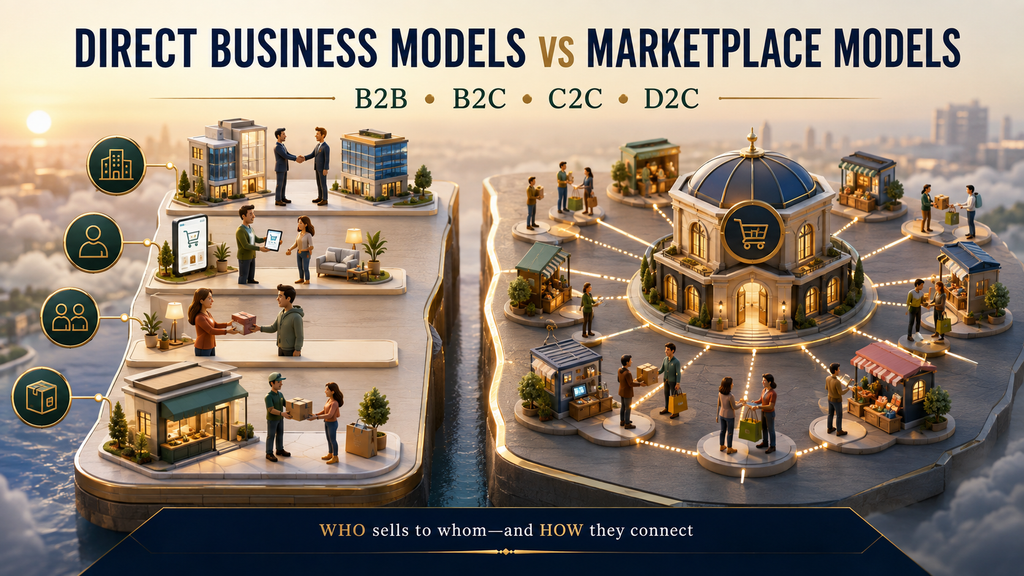
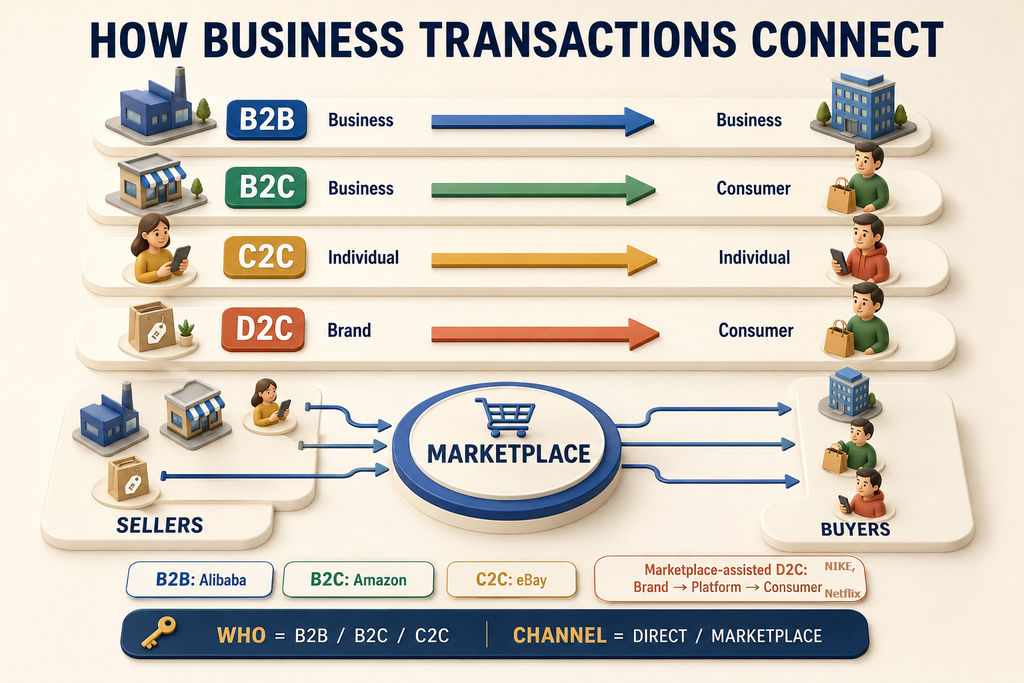
B2B, B2C and C2C identify who sells to whom. A marketplace describes how sellers and buyers connect. D2C describes a brand or manufacturer selling its own products directly to consumers.
Understanding this distinction makes it much easier to classify ecommerce businesses, digital platforms and traditional companies correctly.
What Is a Direct Business Model?
In a direct business model, a seller deals with the buyer through its own sales channel instead of relying on a third-party marketplace to facilitate the transaction. The channel could be the seller’s website, application, sales team, physical store or another company-owned platform.
However, the word direct should be used carefully. B2B, B2C and C2C do not automatically mean that a transaction is direct. These abbreviations define the parties involved, and each model may operate directly or through a marketplace.
What Is a Marketplace Model?
A marketplace is an intermediary platform that connects multiple sellers or service providers with multiple buyers. Sellers list their products or services, buyers compare the available offerings, and the platform facilitates discovery, communication, payment, fulfilment or other parts of the transaction.
A marketplace may generate revenue through:
- Seller registration or subscription fees
- Commission on each completed sale
- Product or service listing fees
- Advertising and promoted listings
- Payment-processing charges
- Delivery, fulfilment or logistics fees
- Premium seller services
Amazon, Flipkart, Alibaba.com, IndiaMART, OLX and eBay are familiar examples, although their audiences and transaction models differ.
B2B: Business to Business
B2B refers to a transaction in which one business sells a product or service to another business.
Direct B2B example: Adobe provides software subscriptions and enterprise solutions directly to another company.
Adobe → Business customerB2B transactions commonly include enterprise software, consulting, manufacturing supplies, wholesale products and professional services. They often involve contracts, negotiated pricing, bulk quantities and longer sales cycles.
B2B Marketplace
A B2B marketplace connects multiple business sellers with multiple business buyers.
Examples: IndiaMART and Alibaba.com.
Business sellers → B2B marketplace → Business buyersFor example, several manufacturers can list industrial equipment on Alibaba.com, allowing retailers, wholesalers and other companies to compare suppliers and purchase products in bulk.
B2C: Business to Consumer
B2C refers to a business selling products or services to individual end consumers.
Direct B2C example: Netflix provides its streaming service directly to consumers through its own digital platform.
Netflix → End consumerOther direct B2C examples include a restaurant selling meals to customers or a software company selling individual subscriptions through its own website.
B2C Marketplace
A B2C marketplace allows multiple business sellers to offer products or services to end consumers through one platform.
Examples: Amazon Marketplace, Flipkart and Walmart Marketplace.
Business sellers → B2C marketplace → End consumersThe marketplace may manage product discovery, payments, customer reviews, delivery and returns while charging sellers commissions or service fees.
C2C: Consumer to Consumer
C2C refers to a transaction between two individuals. One person acts as the seller, while another acts as the buyer.
Direct C2C example: One person sells a used laptop directly to a friend or neighbour.
Individual seller → Individual buyerC2C Marketplace
A C2C marketplace provides a platform on which individuals can list and sell products to other individuals.
Examples: OLX, eBay and Facebook Marketplace.
Individual sellers → C2C marketplace → Individual buyersThe platform makes it easier for buyers and sellers to discover each other. Depending on the platform, it may also provide messaging, payments, ratings or buyer-protection services.
D2C or DTC: Direct to Consumer
D2C and DTC both mean Direct to Consumer. This model applies when a brand or manufacturer sells its own products directly to consumers, avoiding traditional independent wholesalers, distributors and retailers.
Best D2C example: Nike selling its products through Nike.com or a Nike-owned store.
Nike → ConsumerD2C is a specific form of B2C. Every D2C transaction is B2C because a business sells to a consumer, but not every B2C transaction is D2C.
For example, Nike selling through Nike.com is D2C. An independent retailer selling Nike shoes to a consumer is B2C, but it is not Nike’s D2C channel.
Why Brands Use D2C
The D2C model can provide brands with:
- Greater control over brand presentation and customer experience
- Direct access to customer feedback and first-party data
- More control over pricing and promotions
- Reduced dependence on traditional distributors and retailers
- Opportunities to build memberships, loyalty programmes and subscriptions
At the same time, the brand becomes more responsible for marketing, technology, payments, fulfilment, returns and customer service.
Is There a D2C Marketplace?
The phrase D2C marketplace is used in ecommerce discussions, but it can be confusing. A pure D2C transaction normally occurs through a brand-owned channel. When a third-party marketplace facilitates the transaction, the platform becomes an intermediary.
Therefore, marketplace-assisted D2C or D2C brand marketplace is usually more precise.
Example: An original brand sells its own products to consumers through Amazon Launchpad.
Brand → Marketplace platform → ConsumerAmazon Launchpad is a useful example of marketplace-assisted D2C because it helps emerging brands present and sell their products to consumers. Etsy may also resemble this model when original makers sell products they produce themselves. Platforms such as Nykaa or Myntra can facilitate direct brand storefronts, although the exact commercial and fulfilment arrangements may vary.
The three channels can be distinguished as follows:
| Channel | Transaction flow | Example |
|---|---|---|
| Pure D2C | Brand → Consumer | Nike → Nike.com customer |
| Marketplace-assisted D2C | Brand → Marketplace → Consumer | Brand → Amazon Launchpad → Customer |
| Traditional retail | Brand → Distributor/Retailer → Consumer | Brand product sold by an independent retailer |
Direct Models vs Marketplace Models
| Model | What it defines | Direct example | Marketplace example |
| B2B | Business sells to business | Adobe → Company | IndiaMART, Alibaba.com |
| B2C | Business sells to consumer | Netflix → Consumer | Amazon, Flipkart |
| C2C | Individual sells to individual | Person → Person | OLX, eBay |
| D2C/DTC | Brand sells its own products directly to consumers | Nike → Nike.com customer | Amazon Launchpad as marketplace-assisted D2C |
The easiest way to remember the distinction is:
- Who is selling to whom? B2B, B2C or C2C
- How do they connect? Directly or through a marketplace
- Is the brand selling its own product directly? D2C or DTC
Can One Company Use Multiple Business Models?
Yes. A company can operate through several models simultaneously.
Nike is a useful example:
- Nike selling through Nike.com is D2C and B2C.
- Nike supplying products to an independent retailer is B2B.
- The retailer selling those products to customers is B2C.
- Nike or an authorised seller using a marketplace introduces a marketplace-assisted channel.
The correct classification therefore depends on the specific transaction, customer and sales channel—not only on the company’s name.
Frequently Asked Questions
Are B2B and a B2B marketplace the same?
No. B2B describes a transaction between businesses. A B2B marketplace is an intermediary platform connecting multiple business sellers with business buyers. Every B2B marketplace facilitates B2B transactions, but every B2B company is not a marketplace.
Are B2C and a B2C marketplace the same?
No. A company may sell directly to a consumer through its own channel, or multiple businesses may sell to consumers through a B2C marketplace.
Is Amazon a B2C company or a marketplace?
Amazon can operate as both a retailer and a marketplace. When Amazon sells inventory itself, it acts as a B2C retailer. When third-party businesses sell through Amazon Marketplace, the platform facilitates B2C marketplace transactions.
Is D2C the same as B2C?
D2C is a narrower type of B2C. In D2C, the original brand or manufacturer sells its own products directly to consumers. B2C also includes retailers selling products made by other brands.
Is a D2C marketplace truly direct?
Not completely. A third-party marketplace remains involved in facilitating the transaction. That is why marketplace-assisted D2C is a more accurate description.
Conclusion
B2B, B2C and C2C classify transactions according to the seller and buyer involved. A marketplace describes an intermediary platform that connects multiple sellers and buyers. D2C is a particular form of B2C in which a brand or manufacturer sells its own products directly to consumers.
In one sentence:
B2B, B2C and C2C define who sells to whom; direct and marketplace models define how they connect; D2C identifies a brand selling its own products directly to consumers.
Suggested image alt text: 3D illustration comparing direct B2B, B2C, C2C and D2C business models with B2B, B2C, C2C and marketplace-assisted D2C platforms.
Suggested social excerpt: Understand the difference between B2B, B2C, C2C and D2C—and learn how direct sales differ from marketplace transactions through examples including Adobe, Netflix, Nike, Amazon, Alibaba and OLX.