
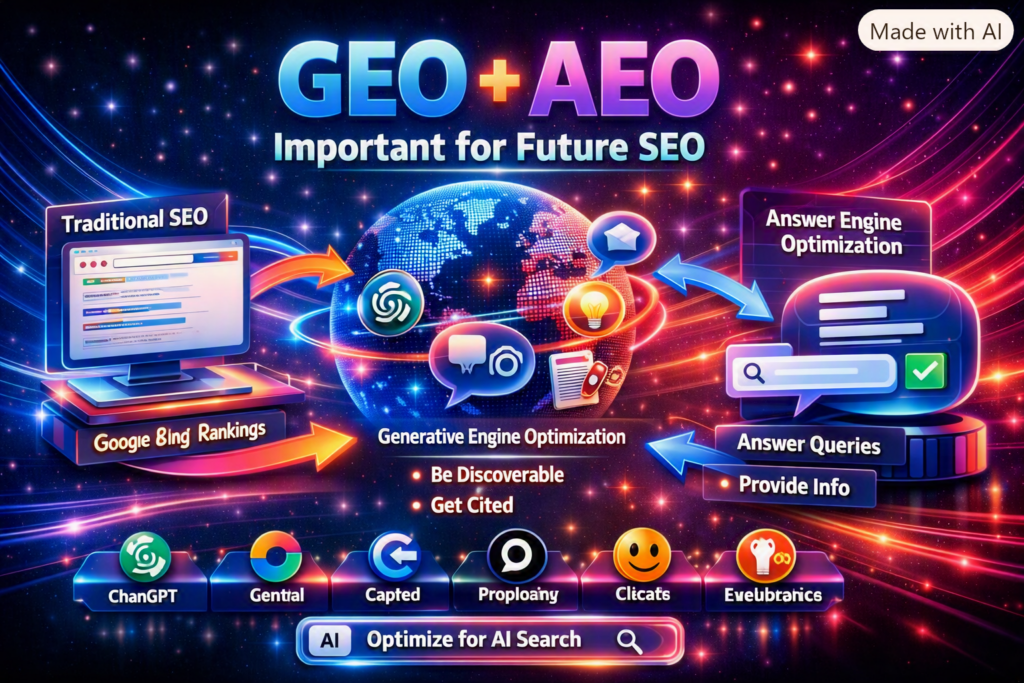
Search is changing rapidly. People no longer rely only on traditional Google result pages to find information. They increasingly ask complete questions inside ChatGPT, Gemini, Perplexity, Claude, Microsoft Copilot, DuckDuckGo and other AI-powered platforms.
These platforms can generate direct answers, summarize information and cite websites as supporting sources. Consequently, website owners must think beyond traditional Search Engine Optimization.
Two approaches are becoming increasingly important:
- Generative Engine Optimization (GEO)
- Answer Engine Optimization (AEO)
Technical accessibility is an essential part of both strategies. If search engines and supported AI crawlers cannot access your website, your content may have fewer opportunities to be discovered, understood or cited in AI-generated answers.
This guide explains how modern AI crawlers work, how to configure your robots.txt file and what else your website needs to become a credible source for AI search.
Important: Allowing an AI crawler does not guarantee that your website will be indexed, ranked or cited. It only gives the supported platform permission to access eligible public content. Content quality, relevance, authority, technical health and user value remain essential.
What Is Generative Engine Optimization?
Generative Engine Optimization, commonly called GEO, is the process of improving content so that generative AI platforms can:
- Discover it
- Understand its meaning
- Evaluate its credibility
- Retrieve relevant information
- Use it to support generated answers
- Attribute or cite the original website
Traditional SEO typically focuses on visibility in search-result listings. GEO also considers whether the content can become a trusted source within an AI-generated response.
For example, a user may ask:
What is the recommended size for an Open Graph image?
An AI platform may provide a direct answer and cite a reliable page that clearly explains the recommended dimensions, aspect ratio, platform differences and practical limitations.
A GEO-ready page should therefore provide accurate, specific and well-supported information that is easy to retrieve and verify.
What Is Answer Engine Optimization?
Answer Engine Optimization, or AEO, focuses on making website content suitable for direct answers.
It can support visibility in:
- AI-generated answers
- Featured snippets
- Voice-search responses
- People Also Ask results
- Search summaries
- Conversational assistants
- Question-and-answer interfaces
AEO content normally includes:
- A clear question or problem
- A concise answer near the beginning
- Descriptive headings
- Definitions
- Numbered instructions
- Comparison tables
- Visible frequently asked questions
- Supporting explanations
- Primary sources
- Appropriate structured data
For example:
What is a meta description?
A meta description is an HTML element that provides a brief summary of a webpage. Search engines may use it when generating a search-result snippet, although they can select different text from the page when it better matches the search query.
The direct answer appears first, followed by supporting details. This structure helps both readers and retrieval systems.
GEO, AEO and SEO Work Together
GEO and AEO should not replace SEO.
Google explains that its established SEO practices remain relevant to generative search experiences. Pages still need to be crawlable, indexable, useful, reliable and technically well structured.
A successful strategy combines all three:
| Discipline | Primary objective |
|---|---|
| SEO | Earn visibility in traditional search results |
| AEO | Provide clear responses to specific questions |
| GEO | Become a credible source for generative AI answers |
| Technical SEO | Make pages accessible, indexable and understandable |
| Entity optimization | Establish who created and maintains the information |
| Digital authority | Earn trustworthy mentions, links and independent validation |
What Is an AI Search Crawler?
An AI search crawler is an automated system that visits public webpages to discover, retrieve or understand content for an AI-powered search experience.
Different crawlers can have different purposes:
- Search crawlers discover content that may appear in search or AI-generated results.
- User-requested fetchers retrieve a page after a user asks an assistant to access it.
- Model-training crawlers collect eligible information that may be used to improve future AI models.
- Grounding controls determine whether indexed content can support an AI model at response time.
These purposes should not be treated as identical.
For example:
OAI-SearchBotis associated with ChatGPT search discovery.GPTBotcontrols potential OpenAI model-training access.Claude-SearchBotsupports Claude search visibility.ClaudeBotrelates to Anthropic model-training access.PerplexityBothelps Perplexity surface and link websites in its search results.Google-Extendedcontrols certain Gemini training and grounding uses but does not influence Google Search rankings.
Website owners can make separate decisions about search visibility and model-training access.
How robots.txt Supports AI Search Discovery
The robots.txt file is a publicly accessible text file placed at the root of a website:
https://example.com/robots.txtIt tells compliant crawlers which areas of a website they are permitted to request.
A simple rule looks like this:
User-agent: ExampleBot
Allow: /
This means the identified crawler is allowed to request the entire public website.
To block a crawler from the complete site, the rule would be:
User-agent: ExampleBot
Disallow: /
The robots.txt file manages crawling. It is not a security system and should never be used to protect confidential information. Sensitive content should be protected through authentication and proper authorization.
Complete robots.txt Example for SEO and AI Crawlers
The following example allows traditional search crawlers, AI search crawlers, user-requested fetchers and selected model-training crawlers.
Replace the sitemap URL with the correct canonical sitemap for your domain.
# robots.txt for SEOEnquiry.com
# Allow search engines and supported AI crawlers

User-agent: *
Allow: /

# OpenAI search and user-requested access
User-agent: OAI-SearchBot
Allow: /

User-agent: ChatGPT-User
Allow: /

# OpenAI model-training crawler
User-agent: GPTBot
Allow: /

# Perplexity search and user-requested access
User-agent: PerplexityBot
Allow: /

User-agent: Perplexity-User
Allow: /

# Anthropic search and user-requested access
User-agent: Claude-SearchBot
Allow: /

User-agent: Claude-User
Allow: /

# Anthropic model-training crawler
User-agent: ClaudeBot
Allow: /

# Google Search
User-agent: Googlebot
Allow: /

# Microsoft/Bing Search
User-agent: Bingbot
Allow: /

# Google Gemini training and grounding control
User-agent: Google-Extended
Allow: /

# Apple generative-AI training control
User-agent: Applebot-Extended
Allow: /

# Common Crawl
User-agent: CCBot
Allow: /

# ByteDance
User-agent: Bytespider
Allow: /

#Alexa/Amazon AI
User-agent: Amazonbot
Allow: /

#DuckDuckGo's AI assistant
User-agent: DuckAssistBot
Allow: /

Sitemap: https://seoenquiry.com/sitemap.xml
What Each AI Crawler Does
OAI-SearchBot
OAI-SearchBot is used for OpenAI search-related discovery. OpenAI recommends not blocking it if publishers want their public content to be eligible for inclusion in ChatGPT summaries, snippets and linked search results.
OpenAI also states that ChatGPT search referral links can include:
utm_source=chatgpt.comThis allows publishers to identify some ChatGPT referral traffic in analytics.
Learn more from the OpenAI publisher and developer guidance.
ChatGPT-User
ChatGPT-User may retrieve content in response to a user-initiated request. This is different from systematic search crawling and model training.
Allowing it can help ChatGPT access a public page when a user asks it to examine or use that page.
GPTBot
GPTBot is associated with potential OpenAI model-training access.
Allowing it does not guarantee that:
- The content will be used for training
- ChatGPT will remember the website
- The brand will appear in answers
- The page will receive citations
- Search visibility will improve
Website owners who want ChatGPT search visibility but do not want to permit potential training can allow OAI-SearchBot while blocking GPTBot.
PerplexityBot
PerplexityBot is designed to discover content that may be surfaced and linked in Perplexity search results.
Perplexity recommends allowing it and ensuring that security systems accept requests from its published IP ranges. Perplexity crawler documentation
Perplexity-User
Perplexity-User supports requests initiated by Perplexity users. It may access a webpage to help answer a question and provide a link to the source.
It is not described as a model-training crawler.
Claude-SearchBot
Claude-SearchBot navigates the public web to improve the quality, relevance and accuracy of Claude’s search responses.
Blocking it may reduce a website’s visibility in Claude search experiences.
Claude-User
Claude-User can access websites when a Claude user asks a question that requires retrieving public web content.
Allowing it may help Claude retrieve and reference your content during a user-requested search.
ClaudeBot
ClaudeBot is associated with Anthropic’s model-development and training collection.
It can be controlled independently from Claude-SearchBot and Claude-User. This allows publishers to permit Claude search access while declining potential model-training access.
See Anthropic’s crawler guidance.
Googlebot
Googlebot crawls webpages for Google Search.
Google’s AI search features are built on its search and ranking systems. A page generally needs to be crawlable and eligible for Google Search before it can become eligible for visibility in supported generative search experiences.
Bingbot
Bingbot discovers and indexes content for Bing.
Bing’s index can support multiple Microsoft search and AI experiences. Website owners should also use Bing Webmaster Tools and IndexNow to help Bing discover updated content efficiently.
Google-Extended
Google-Extended is a control token rather than a separate crawler that independently requests pages.
It controls whether content collected by Google may be used for certain Gemini model-training and grounding purposes. Google explicitly states that allowing or blocking Google-Extended does not affect Google Search inclusion or ranking.
See Google’s crawler documentation.
Applebot-Extended
Applebot-Extended helps publishers control whether content retrieved by Applebot may be used for training Apple’s generative foundation models.
It does not independently crawl pages, and blocking it does not necessarily prevent inclusion in Apple search experiences.
CCBot
CCBot is operated by Common Crawl, which maintains a large public web-crawl dataset.
Various research and AI projects may use Common Crawl data. Allowing CCBot may support broader data availability, but it does not guarantee brand visibility, AI ranking or citations.
Bytespider
Bytespider is associated with ByteDance web crawling.
Publishers should decide whether to allow it based on their distribution strategy, server capacity, licensing preferences and data-use policies.
Amazonbot
Amazonbot is associated with Amazon services, including systems that may support search and assistant experiences.
Its exact use can evolve, so publishers should review Amazon’s current official crawler documentation before relying on it for a specific Alexa or AI-search outcome.
DuckAssistBot
DuckAssistBot retrieves webpages in real time for DuckDuckGo’s AI-assisted answers, which can prominently cite their sources.
DuckDuckGo states that DuckAssistBot data is not used to train AI models. Blocking it does not affect normal DuckDuckGo organic-search ranking, but it removes the website from eligibility as a potential source for DuckDuckGo’s AI-assisted answers.
See the DuckDuckGo DuckAssistBot documentation.
Should You Allow Model-Training Crawlers?
This is a business and content-licensing decision.
You may choose maximum access:
User-agent: GPTBot
Allow: /
User-agent: ClaudeBot
Allow: /
User-agent: Google-Extended
Allow: /
User-agent: Applebot-Extended
Allow: /
Alternatively, you may allow search and user-requested access while blocking potential model-training use:
Allow search visibility User-agent:
OAI-SearchBot Allow: / User-agent:
ChatGPT-User Allow: / User-agent:
Claude-SearchBot Allow: / User-agent:
Claude-User Allow: / User-agent:
PerplexityBot Allow: / User-agent:
Perplexity-User Allow: / User-agent:
DuckAssistBot Allow: /
# Decline potential model-training access User-agent:
GPTBot Disallow: / User-agent:
ClaudeBot Disallow: / User-agent:
Google-Extended Disallow: / User-agent:
Applebot-Extended Disallow: /
Blocking a training crawler does not necessarily mean that the website must disappear from the same company’s search experience. Search, user retrieval and model training can have separate controls.
robots.txt Is Only the First Step
A perfect robots.txt file cannot make weak content rank or earn citations.
After enabling appropriate crawlers, complete the following work.
1. Verify indexability
Important pages should:
- Return an HTTP
200response - Not contain
noindex - Not be blocked by login requirements
- Use a self-referencing canonical URL
- Appear in the XML sitemap
- Be accessible without CAPTCHA challenges
- Provide meaningful content in crawlable HTML
2. Check CDN and firewall access
A crawler may be permitted in robots.txt but still blocked by:
- Cloudflare
- Web application firewalls
- Bot-protection systems
- Rate limits
- Hosting restrictions
- Geographic rules
- JavaScript challenges
Where supported, validate crawlers using their officially published IP ranges rather than trusting the user-agent string alone.
3. Provide answer-ready content
Each important article should include:
- A descriptive title
- One clear H1
- A direct introductory answer
- Logical H2 and H3 headings
- Definitions
- Step-by-step instructions
- Examples
- Limitations
- Supporting evidence
- Frequently asked questions
- Primary references
- A review or update date
4. Add accurate structured data
Use schema that matches the visible content.
Relevant schema types can include:
OrganizationWebSiteWebPageArticleTechArticleWebApplicationSoftwareApplicationFAQPageHowToBreadcrumbListPersonVideoObjectDataset
Structured data helps systems understand page entities, but there is no special “GEO schema” that guarantees AI citations.
5. Establish website identity
Create and maintain:
- About page
- Contact page
- Author profiles
- Editorial policy
- Testing methodology
- Corrections policy
- Privacy policy
- Terms of use
- Consistent organization details
- Genuine social and professional profiles
AI systems are more likely to trust information when they can understand who created it, how it was produced and whether it can be independently verified.
6. Publish original evidence
Generic articles are easy to reproduce and difficult to differentiate.
Create citation-worthy assets such as:
- Original industry research
- Product tests
- Website audits
- Benchmarks
- Technical experiments
- Calculators
- Public datasets
- Case studies
- Transparent comparisons
- Expert commentary
For example, SEOEnquiry could publish a study analysing 10,000 websites to identify:
- How many lack meta descriptions
- How many have canonical conflicts
- How many omit Open Graph images
- How many have incomplete X Card metadata
- How many use invalid robots directives
- Which structured-data types appear most frequently
Original findings give AI platforms a stronger reason to cite the source.
7. Build genuine authority
Improve off-site signals through:
- Relevant editorial backlinks
- Expert contributions
- Research citations
- GitHub projects
- YouTube demonstrations
- Technical community participation
- Partnerships
- Reputable directory profiles
- Brand mentions from independent sources
Do not purchase artificial mentions or publish mass-generated pages solely to manipulate AI answers.
Submit and Monitor Your Website
After publishing the updated robots.txt file:
- Verify Google Search Console.
- Verify Bing Webmaster Tools.
- Submit the XML sitemap.
- Implement IndexNow.
- Inspect important URLs.
- Test structured data.
- Review server logs for crawler visits.
- Confirm that the CDN is not returning
403. - Monitor indexed pages.
- Track AI-generated referral traffic.
ChatGPT referral links may include:
utm_source=chatgpt.comAlso monitor identifiable traffic from:
- Perplexity
- Microsoft Copilot
- Gemini or Google AI experiences
- Claude
- DuckDuckGo
- Other assistant platforms
Maintain a fixed list of important questions and test them periodically across different AI platforms.
Common Mistakes to Avoid
Assuming crawler access guarantees citations
It does not. Crawler access provides technical eligibility, not guaranteed selection.
Allowing every crawler without reviewing data use
Search discovery and model training are different. Decide deliberately which types of access support your business goals.
Blocking crawlers in the firewall
An Allow: / rule will not help if Cloudflare or another security layer returns 403 Forbidden.
Adding FAQ schema without visible FAQs
Structured data should describe visible page content.
Publishing generic AI-generated articles
Content that merely repeats common information provides little reason for an answer engine to cite it.
Creating an llms.txt file and expecting rankings
Some services may use llms.txt, but Google states that it is not required for Google Search or Google’s generative search features. It should not replace standard crawling, indexing and content-quality work.
Forgetting the sitemap domain
Always use the correct canonical domain:
Sitemap: https://seoenquiry.com/sitemap.xmlDo not accidentally reference the sitemap of another website.
Frequently Asked Questions
Does allowing OAI-SearchBot guarantee a ChatGPT citation?
No. It allows eligible public content to be crawled for search-related discovery. Relevance, quality, authority and other systems determine whether a page is used or cited.
Is GPTBot required for ChatGPT Search?
GPTBot and OAI-SearchBot have different purposes. A publisher can allow OAI-SearchBot for search visibility while blocking GPTBot for potential model-training use.
Does Google-Extended improve Google rankings?
No. Google states that Google-Extended does not affect Google Search inclusion or ranking.
Can robots.txt prevent a page from being indexed?
Robots.txt controls crawling, not guaranteed indexing. To remove a page from search results, use an appropriate noindex directive while allowing the crawler to access and read it, or protect the content with authentication.
Is schema required for AI citations?
No. Accurate structured data can help systems understand entities and page meaning, but it does not guarantee AI visibility or citations.
Should every website allow all AI crawlers?
Not automatically. Website owners should evaluate search visibility, model training, licensing, server resources, privacy and commercial objectives before selecting crawler permissions.
How long does it take to appear in AI answers?
There is no guaranteed timeline. Discovery, indexing, evaluation and citation selection vary by platform and query.
Final Checklist
Before expecting visibility in AI search, confirm that your website has:
- A valid
robots.txt - The correct XML sitemap URL
- Search and AI crawlers permitted according to your policy
- No unintended
noindex - Consistent canonical URLs
- Crawlable HTML content
- A working sitemap
- Search Console and Bing verification
- IndexNow implementation
- Clear answer-first content
- Accurate structured data
- Organization and author information
- Original data or expertise
- Authoritative references
- Relevant internal links
- Genuine external mentions
- Fast mobile performance
- Accessible navigation and content
- AI referral and citation monitoring
Conclusion
Modern search optimization is no longer limited to blue links and keyword rankings. Websites must be technically accessible, answer-ready, trustworthy and useful enough to support AI-generated responses.
A carefully configured robots.txt file is an important starting point. It gives supported search engines and AI platforms permission to access public content. However, lasting GEO and AEO success depends on much more:
- Helpful original information
- Transparent evidence
- Strong technical SEO
- Clear entity signals
- Accurate structured data
- Genuine authority
- Continuous measurement
The right objective is not to “train every chatbot” to promote your website. The sustainable objective is to make your website one of the clearest, most reliable and most verifiable sources available for the questions your audience asks.
When that happens, traditional search engines and AI answer engines have a stronger reason to discover, trust and cite your content.